
What is Strategic Academy?About the Strategic Academy
The Strategic Academy is an education program organized by our company (Strategic Partners Inc.) for in-house staff, partners, and others. Through learning and hands-on work at the Academy, we develop more people, more efficiently, who can carry out their work with a strategic perspective.
At this Academy, participants comprehensively study six categories—“1. Research & Analysis,” “2. Corporate Strategy,” “3. Business Strategy,” “4. Marketing,” “5. Management,” and “6. Operations”—based on the effective and practical strategic framework “6e.” The goal is for participants to be able to understand the strategy required for their role, plan, and smoothly switch into execution in their work.
Courses are set for each target group, and there are four: ① Strategist Course, ② Producer Course, ③ Account Executive (Sales) Course, and ④ Solution Manager Course.
*This training is not open to the public and is available only to our employees and Partners.
Background to the launch of the Strategic Academy
Currently, the practical work of consultants, producers, directors, and others tends to depend on specific individuals and is often carried out by relying on experience. As a result, reproducibility is poor, giving rise to challenges such as inconsistent results and difficulty in training. There is also the risk that biased knowledge or assumptions lead to the execution of measures that are actually counterproductive.
Meanwhile, new insights are emerging in the field in response to changes in the market environment and technology, but in many cases they are not systematically accumulated or shared, and academic knowledge is not fully utilized in practice either.
Against this background, we are establishing an in-house academy as a place to learn “6e,” an adaptive framework that integrates insights from practice and research. By giving everyone a common foundation of thinking, we develop people with strong execution capabilities and high reproducibility.
Objectives of the Strategic Academy
1. Strengthening organizational capability
By increasing the number of people who understand “6e” across job functions and can discuss and execute within the same framework, we enhance the coordination and execution capabilities of the entire organization.
2. Promoting comprehensive understanding
To arrive at fundamental solutions to increasingly complex and diverse client challenges, the ability to grasp the overall structure—rather than fragmented knowledge—is required. At the Academy, participants learn the perspectives of management, strategy, and expression in a cross-cutting way, acquiring the ability to think strategically.
3. Sharing reproducible knowledge
Rather than know-how that depends on individual rules of thumb, we accumulate and share insights backed by practice as explicit knowledge, creating a foundation on which anyone can reproduce results.
Academy ScheduleAcademy Schedule
FY2025–2026 Schedule (Tentative)
| Date & Time | Course |
|---|---|
| 2025 11/28 (Fri) 13:00–16:00 | Intermediate Strategist Course Eligibility: Completed the 6e Beginner Course |
| 12/19 (Fri) 13:00–16:00 | Strategic Creative Course: Video Eligibility: Completed the 6e Beginner Course |
| 2026 1/23 (Fri) 13:00–16:00 | Strategic Creative Course: Events Eligibility: Completed the 6e Beginner Course |
| 2/27 (Fri) 13:00–16:00 | Strategic Creative Course: Web & Graphics Eligibility: Completed the 6e Beginner Course |
| 3/27 (Fri) 13:00–16:00 | Advanced Strategist Course Eligibility: Completed the Intermediate Strategist Course |
| 4/24 (Fri) 13:00–16:00 | 6e Beginner Course Eligibility: Must be a Partner |
| 5/22 (Fri) Afternoon | ① Account Executive Course Eligibility: Completed the 6e Beginner Course ② Solution Manager Course Eligibility: Completed the 6e Beginner Course |
| 6/26 (Fri) 13:00–16:00 | Intermediate Strategist Course Eligibility: Completed the 6e Beginner Course |
| 7/24 (Fri) 13:00–16:00 | Strategic Creative Course: Video Eligibility: Completed the 6e Beginner Course |
| 8/21 (Fri) 15:00–18:00 | Strategic Creative Course: Events Eligibility: Completed the 6e Beginner Course |
| 9/25 (Fri) 13:00–16:00 | Strategic Creative Course: Web & Graphics Eligibility: Completed the 6e Beginner Course |
| 10/23 (Fri) 13:00–16:00 | Advanced Strategist Course Eligibility: Completed the Intermediate Strategist Course |
| 11/27 (Fri) 13:00–16:00 | 6e Beginner Course Eligibility: Must be a Partner |
| 12/18 (Fri) 13:00–16:00 | Intermediate Strategist Course Eligibility: Completed the 6e Beginner Course |
| 2027 1/22 (Fri) 13:00–16:00 | Strategic Creative Course: Video Eligibility: Completed the 6e Beginner Course |
| 2/26 (Fri) 13:00–16:00 | Strategic Creative Course: Events Eligibility: Completed the 6e Beginner Course |
| 3/26 (Fri) 13:00–16:00 | Strategic Creative Course: Web & Graphics Eligibility: Completed the 6e Beginner Course |
Fields of Study in 6e at the AcademyFields of 6e Studied at the Academy
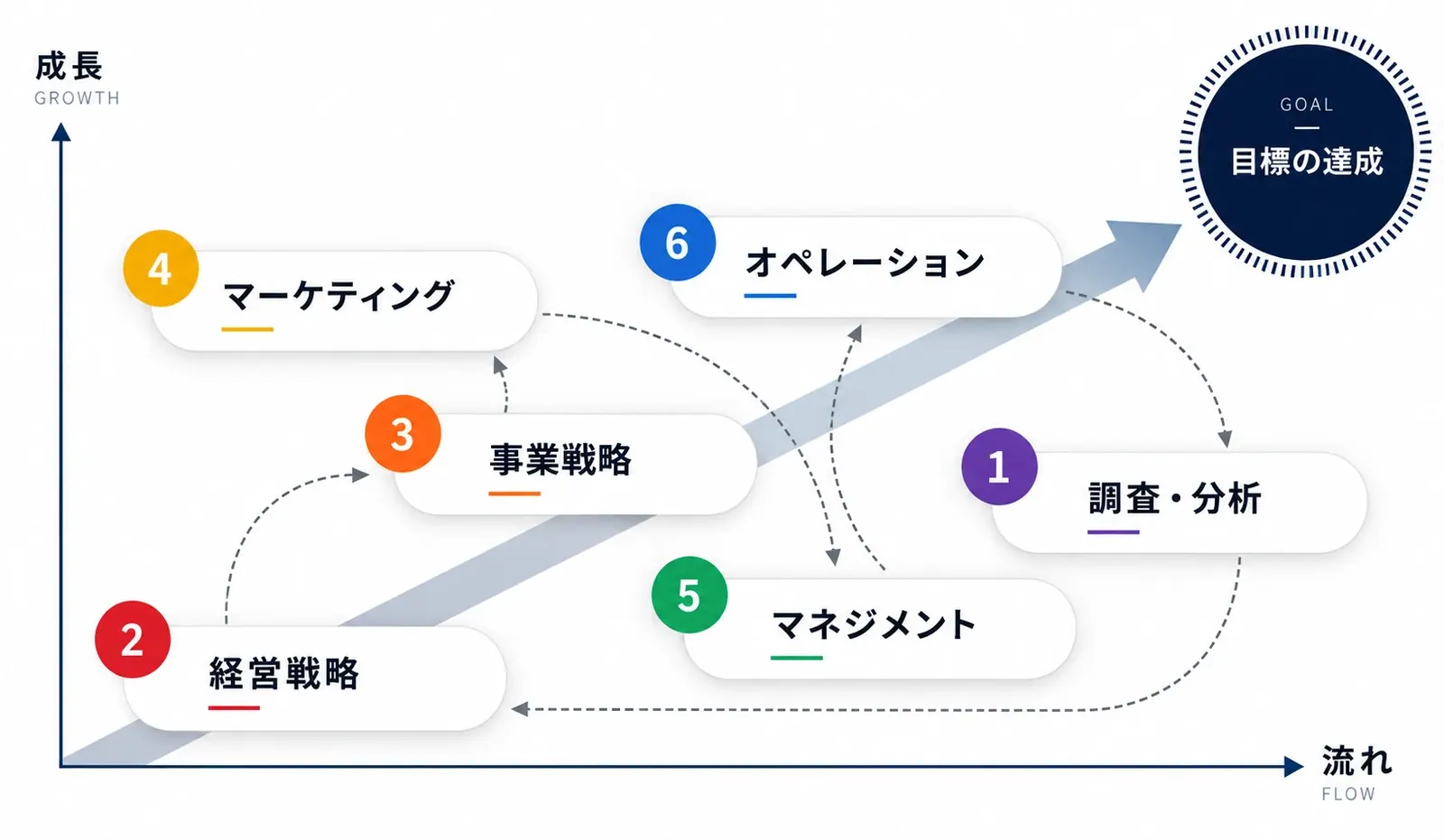
01 Research & Analysis
Using the “6e” framework as a foundation, research and analysis are essential for exploring the challenges facing a company and its services and products, forming hypotheses, testing them, and designing the optimal strategy. By conducting analysis based on research findings, we review current strategies and derive guidelines for strategic planning.
02 Corporate Strategy
Designing and managing strategy is important to ensure that corporate strategy is reliably executed. However, designing and managing strategy requires guiding principles such as “What does the company aim to achieve?”, “What kind of company should it be in the eyes of society?”, and “What will the company do?” These lead to the formulation of business strategy and to strategic planning that addresses every phase of corporate management.
03 Business Strategy
Whereas corporate strategy and company-wide strategy, which concern the company or corporate group as a whole, design the selection of businesses and the allocation of resources among multiple businesses, business strategy (or competitive strategy) designs how to build and maintain an advantage in each individual business unit.
04 Marketing
We plan all marketing activities—product strategy, pricing strategy, promotion strategy including PR, web, events, mass media, in-store, OOH, and campaigns, as well as distribution strategy and sales strategy—based on the marketing concept we have derived, and make proposals in line with the creative.
Basically, we consider and implement these in accordance with the 4Ps. The 4Ps are the main controllable elements of the marketing mix, one of the processes for planning and executing marketing strategy. They are called the 4Ps after the initials of Product, Price, Place (distribution), and Promotion (communication).
05 Management
Management is a method of managing various resources, assets, risks, and so on, mainly in business, in order to optimize business performance. Management is generally translated as “control” in Japanese, but the various management theories that emerged from management administration theory include, besides “control,” many other elements such as “evaluation, analysis, selection, improvement, avoidance, integration, planning, coordination, direction, control, and organization,” and the concept that combines all of these is called management activity.
06 Operations
Once a strategy has been set, it is not easily changed, but in the course of implementing it, it is important to verify its effects and results and make improvements to any bottlenecks. In Operations, following the PDCA cycle (repeating the four stages of Plan → Do → Check → Act), we conduct follow-up research on the results of the strategy implemented and, using feedback from the research findings, refine it into a more accurate strategy.
In-house certification systemAbout the In-House Certification System
Strategic Partners has adopted an in-house certification system. There are two types of certification, as follows.
*This training is not open to the public and is available only to our employees and Partners.
In-house certification system menuIn-House Certification Menu
01 Junior Business Strategist (JBS)

Requirements: At least 3 years of practical experience (as an assistant) / Pass the in-house certification exam
02 Master Business Strategist (MBS)

Requirements: Pass the Junior Business Strategist certification / Track record of improving business performance at 10 or more companies / MBA holder or higher (third-party verification required) / In-house review
Note 1) What is a Strategist (corporate strategist)?
A Strategist is a new type of profession that “supports client companies seamlessly from strategic planning (Note 2) through execution support (Note 3).”
You may think the profession closest to a strategist is a consultant, but consultants are, after all, a profession focused on strategy formulation,
and they do not take care of tactics (product production, solution building, organizational design, etc.).
Thus, it is undeniable that the specialists who support client companies, such as consultants and creators, provide only partial support. It is true that precisely because these services are specialized, they can provide highly effective measures. Today, however, client companies' activities span a very broad range. For that reason, it is believed that specialized services alone cannot solve companies' fundamental challenges.
Indeed, corporate activity is described as a “complex system,” and steering amid the intricate interplay of countless elements directly affects business performance. There is a wide variety of things that can be done to respond to a rapidly changing market environment.
That is precisely where the Strategist's reason for being lies. Because they understand the strategy, they can carry out the tactics (product production, solution building, organizational design, etc.) to maximize the strategy's effect,
and they can also achieve the “execution” needed to make the most of the planned strategy.
Looking back, in the past, historical strategists such as Zhuge Liang (Kongming) and Yamamoto Kansuke played active roles. Today, the battlefield has shifted to economic warfare centered on companies.
Hence, the presence and development of Strategists have become important.
Note 2) What is Strategic Planning?
Strategic planning refers to a system of management and planning that includes the strategic level: “from strategy to plans, and from plans to budgets.” It began attracting attention in the 1960s and is still widely used by many companies today as a fundamental mechanism for running organizations.
Specifically, corporate activities are classified into six elements: “1. Research & Analysis,” “2. Philosophy & Business Domain,” “3. Business Strategy,” “4. Marketing,” “5. Management,” and “6. Operations.” In “1. Research & Analysis,” we analyze the environment surrounding the company, services, and products, as well as the target, and design the strategic concept. In “2. Philosophy & Business Domain,” we propose redefinitions of the company's philosophy and domain, and even of its services and products.
In “3. Business Strategy,” we formulate the company's business strategy; in “4. Marketing,” we formulate marketing strategies for the business's products and services; and in “5. Management,” we design measures concerning organization, finance, and so on. Finally, in “6. Operations,” we design the execution plan as well as KPIs and KGIs. This makes it possible to derive answers for every phase of the challenges facing a company and its products and services.
Note 3) What is Execution Support?
“Execution support” refers to a Strategist carrying out strategic planning and supporting execution through to the achievement of KPIs and KGIs. From execution to the realization of goals, we use a variety of methods to support companies thoroughly.