
The Wrong Leadership Puts Your Company at Risk
There are many research papers on the correlation between leadership and corporate performance. In our own experience supporting companies, we have also felt that a company's ups and downs are significantly affected by the leadership of its president, division heads, and others.
Because the quality of leadership is clearly reflected in business performance, it is necessary to reflect once more on your own leadership.
First, the definition of leadership is given below.
Source: https://www.hito-link.jp/media/column/leadership
Leadership is described as “the ability to guide and command,” and refers to the power to prompt individuals and teams to act in order to achieve a certain goal. The basic points are mainly the following three.
- Present a vision for achieving the goal
- Encourage staff while maintaining their motivation so that the vision is realized
- Resolve the problems that arise in realizing the vision
To achieve results as a whole team, the leader's power alone is not enough. What is required is the ability to guide each member to act on their own initiative, deciding how to act while having a positive influence on those around them. Many experts have put forward ideas about leadership over the years. Among them, the theory of leadership advocated by Peter Drucker, the famous management scholar, holds that leadership has nothing to do with charisma, and that a leader is someone people voluntarily “follow.” Drucker defined leadership using the words “work, responsibility, and trust.”
As shown above, this kind of description is the general definition of leadership. Summarized simply, it means “instilling the philosophy and vision,” “giving the team (employees) motivation,” and “solving problems related to the organization.” However, most of the organizations (companies) I have seen were ones where “employees do not trust the leader” and “the leader does not trust the employees.”
One method of checking whether leadership is functioning is the “employee engagement survey.”
This survey is designed to produce high scores if leadership is functioning, on items such as:
- Do employees resonate with the philosophy?
- How much do employees like and trust the company?
- Are there efforts to remove organizational problems?
Companies with low scores have many organizational problems: employees do not trust the president or their superiors, and even correct actions receive negative evaluations. As a result, performance stagnates and turnover rates are high. Conversely, companies with high scores are moving in the opposite direction. Even if the services and products are good, once the organization starts to rot, the company will eventually head toward decline.
Thus, an organization's ups and downs are strongly influenced by leadership, yet there are many cases in which the leaders themselves are not facing up to this problem.
Let me give one example. At a certain company, many mid-level employees in their 40s earn salaries in the 200,000-yen range per month, while the president drives to the office in a luxury car. Naturally, overtime is not paid; it is a truly “black” company. Even so, the president loudly proclaims a vision. The president may indeed be buying the car with his own compensation, but it is obvious that he is receiving high pay, and the employees of that company certainly understand that his pay rests on their meager salaries. It is no wonder that employees are unimpressed when he talks about the company's dreams. (lol)
This example is a problem that comes before leadership, but what I have been thinking recently is how low the EQ* of leaders such as presidents and division heads is.
*EQ stands for “Emotional Intelligence Quotient,” a theory researched in 1990 by American psychologists Peter Salovey and John Mayer. The term EQ itself first appeared in a paper by Keith Beasley. In Japanese it is freely translated as the “intelligence quotient of the heart,” and it is described as the “ability to manage and use emotions well” in work and human relationships.
They can no longer see the organizational friction occurring on the front lines or the feelings of their employees. Reports suggesting this have been coming in from each of our teams...
I have digressed a little, but for all of you reading this column, I hope you will learn about “servant leadership,” which I recommend among the several types of leadership.
What Is Servant Leadership?
“Servant” is a word meaning “one who serves” or “attendant.” In addition, it also refers to a leadership style that serves and supports the creation of an environment in which organization members can fully demonstrate their abilities.
Servant leadership is a supportive form of leadership born from the idea that “a leader first serves others and then guides them.” It is a style of leadership that affirms subordinates' abilities and builds mutually beneficial relationships of trust.
Rather than a style that regards subordinates as incapable and moves them by one-sided orders, it emphasizes presenting the organization's vision, trusting subordinates, cooperating with them, and promoting the growth of the organization as a whole.
Simply put, the idea is that the leader properly conveys the philosophy, vision, and strategy design down to employees, and once actual work begins, the leader stands at the very bottom, supporting employees, business partners, and society.
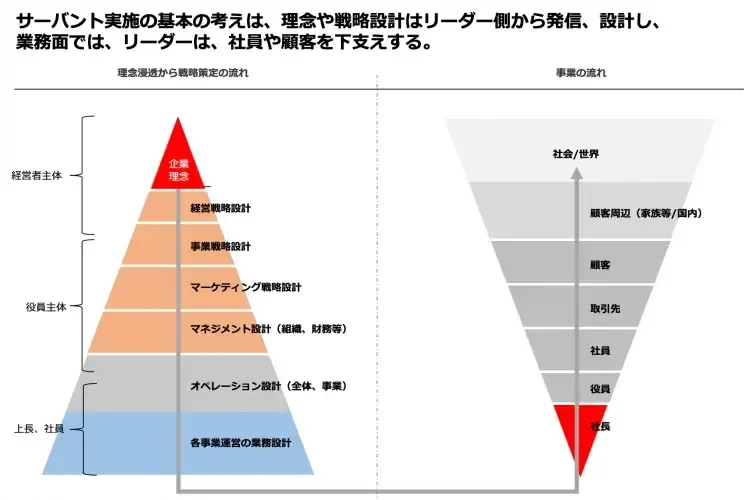
The Ideal Leader in Servant Leadership
What is the ideal image of a leader in servant leadership? What a servant leader needs is a spirit of service. Believing it is their duty to follow their own conscience and lead toward a better world, they run the organization with their subordinates at the center.
Servant leaders value relationships of trust with those around them, listen to their subordinates, and achieve goals through cooperation. The ideal leader can be said to be someone who is mindful of each member's motivation and works to create an environment in which even failures are turned into learning.
The Role of the Servant Leader
In the theory of servant leadership, the leader's major role is “service” to subordinates and members. To do so, the leader must have a spirit of service free from self-interest.
Leadership does not come with charisma or high-ranking authority; in servant leadership, the leader's role is to first serve others and then guide them.
Why It Is Attracting Attention in Modern Society
Possible reasons include a social trend of seeking ethical trustworthiness in leaders amid social anxiety and corruption, as was once the case in the United States, as well as the development of IT and rapidly spreading globalization.
In an age when responding to the speed of worldwide business is considered essential, the approach of one leader managing everything and giving instructions to members cannot keep up. Therefore, members are required to demonstrate their abilities, grow while producing results, and raise their performance.
Precisely because this is an era in which it is important for leaders to understand individual characteristics and qualities and create an environment in which each person can thrive, servant-type leaders came to be considered indispensable.
Why Is Dominant Leadership So Common in Japanese Companies?
The leadership that has been mainstream in Japan until now is what is called “dominant leadership.” This is an image of leadership in which, with strong will, the leader holds firmly to their own ideas and values and pulls subordinates along with strong command.
Toward members, they used their power to communicate through one-sided explanations and orders.
Servant leadership was proposed by Robert K. Greenleaf in 1970, but it has become known in Japan only very recently. Against the backdrop of a drastically changing business environment and the growing demand for diversity in human resources, “servant leadership,” which could be called the exact opposite of conventional leadership, has begun to attract attention.
The Need for Servant Leadership in Modern Business
Servant leadership reverses the conventional organizational idea that “subordinates exist for the leader,” holding instead that “the leader exists to support subordinates.” By respecting subordinates' autonomy and practicing behavior that serves their success and growth, superiors change the behavior of organization members and connect it to improved productivity.
With a leader who listens to each member's voice and respects their autonomy, relationships of trust are nurtured and communication becomes smoother. And members' motivation toward their work increases.
As servant leaders whom subordinates feel “I want to follow this person” have become more prominent, their value and necessity are being recognized anew in comparison with old-fashioned dominant leaders.
| Item | Conventional Leadership | Servant Leadership |
| Motivation | The desire to attain the position of greatest power | The desire to serve others regardless of one's position in the organization |
| Mindset | Emphasizes winning the competition and being praised for one's achievements | Emphasizes a win-win for everyone in an environment where everyone cooperates to achieve goals |
| Basis of Influence | Uses one's own power to move subordinates through fear in order to achieve goals | Moves the organization by building trust with subordinates and respecting their autonomy |
| Communication Style | Centered on explaining to and ordering subordinates | Centered on listening to subordinates |
| Work Thinking Ability | Directs subordinates based on confidence gained from honing one's own abilities | Learns together with subordinates through coaching and mentoring to do better work |
| View of Growth | Grows by understanding and using internal politics to raise one's own position | Values others' motivation and seeks harmony between individual and organizational growth |
| View of Responsibility | Responsibility exists to punish a person when they fail | Creates an environment for learning from failure by clarifying responsibility |
Examples of Servant Leadership Adoption
Here are some examples of companies that have actually adopted servant leadership and succeeded.
●Southwest Airlines
At Southwest Airlines in the United States, about which a book titled “The Company That Loves Its Employees the Most in the World” has even been published, servant leadership has permeated the entire company as a culture, with policies such as “Every employee is a leader” and “Employees come first; customers come second.” This stems from the idea that it is employees who are always in contact with customers, and that supporting employees makes the company and shareholders prosper and leads to customer satisfaction.
As a result, it became famous as the only US airline able to weather the impact of the September 11 terrorist attacks without layoffs.
●Starbucks
According to “It's Not About the Coffee” (Japanese title: “The Important Principles We Kept to Make Starbucks Number One in the World”) by Howard Behar, who as a director of Starbucks grew it into a global coffee chain together with founder Howard Schultz, Starbucks' greatest value standard is “people are everything,” and “the person who serves everyone is the most capable leader.”
The foundation of this way of thinking is servant leadership. In his book, Behar writes that he will donate half of the book's sales to an institute that promotes servant leadership.
●US Air Force
Soldiers in an army cannot fight together on the battlefield without mutual trust. If a commander is resented by the soldiers under them, operations will not go well, and in the worst case, one cannot rule out the possibility of being shot from behind even by one's own side.
For this reason, the US Air Force has a culture that values servant leadership, and even today, strong unity and cohesion based on trust are maintained through this way of thinking.
●Shiseido
Morio Ikeda, Senior Advisor of Shiseido, is a practitioner of servant leadership. He became president with the mission to “rebuild the company” and “make it reborn,” and during his tenure carried out organizational reform with a “store-front-oriented” focus.
He placed servant leadership, which promotes an inverted-pyramid organization with customers at the top, at the core of management, and personally attended meetings of beauty consultants and sales staff to listen to front-line staff. He used ideas gained from what he saw and heard there in his measures and worked hard to create an environment in which employees could work easily, succeeding in numerous management reforms. In his book, he states, “What matters is making employees understand the need for and possibility of change, showing them the goal, and motivating them to head toward it on their own initiative.”
●Ryohin Keikaku
Tadamitsu Matsui, former president of Ryohin Keikaku, which operates MUJI, is also one of the pioneers who adopted servant leadership. Having become president at a time when performance had plummeted, after taking office he visited almost every store in the country on his own feet, creating opportunities to listen to store managers and front-line staff.
Based on the issues that became visible through listening, he developed a manual called “MUJIGRAM” that visualizes operations, and a system for gathering the voices of front-line staff. This can be said to be an example of practicing “conceptualization” and “foresight,” two of the ten characteristics of servant leadership.
After President Matsui took office in 2001, Ryohin Keikaku achieved a V-shaped recovery, and it continues to increase both revenue and profit today.
●Daiei
Next is the example of Yasuyuki Higuchi, former president of the major supermarket chain Daiei. At the time, as a result of deteriorating performance due to top-down management, there were as many as 50 stores that had been running deficits and were slated for closure. He personally visited every one of these stores and directly explained the reasons for the closures to employees and thanked them for their work. As a result, the motivation of staff at those stores improved. Thanks to each staff member's efforts, the “closing clearance sales” were a success, and Daiei recorded year-on-year sales growth for the first time in two years and four months.
Even after the closures, the staff who had received words directly from him maintained their motivation. They then actively reached out to the staff at the stores they were transferred to, and the company achieved year-on-year sales growth for 11 consecutive months.
In Closing
Do you now understand servant leadership? To reiterate, servant leaders run the organization with a spirit of “service,” centered on their subordinates. Because they value relationships of trust and listen to their subordinates, servant leaders cooperate toward the same goal while earning their subordinates' trust.
Because they are mindful of each member's motivation and work to create an environment in which even failures are turned into learning, subordinates can focus on their work with peace of mind and act on their own initiative with ingenuity. I would be delighted if you used this column as a reference to check once again what kind of leader you are and, if necessary, make corrections.
Text: Hiroshi Ashida
●Column articles are scheduled for publication on the 1st of each month.
Column scheduled for August: “What Is a Next-Generation Partner Company?”