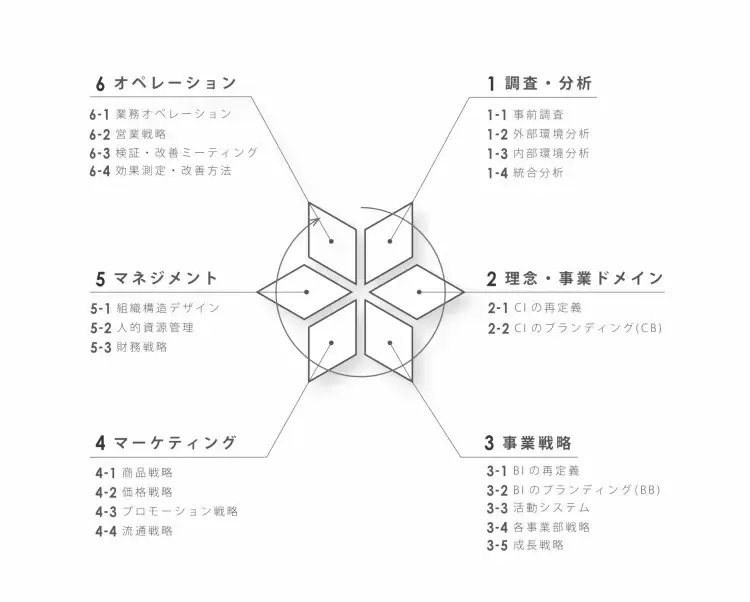
Achieving KGIs through operations strategy
How to build an operations strategy
Operations, as the name suggests, means finally taking practical action. In business, it generally refers to defining the procedures for running and advancing things in order to achieve business goals, as well as the series of tasks and practical plans carried out along those procedures.
No matter how good a corporate strategy you have, a company cannot be run smoothly unless its operations, the concrete processes for realizing that strategy, are solid. For this reason, the operations plan must be designed carefully.
Examples of operations strategy
Operations strategy is one of the measures through which companies explore new developments beyond conventional sales activities. It depends on what you are operating, but you must consider many elements: not only how you deal with customers but also how you give presentations, how you use marketing tools, how you support business partners and so on.
One concept attracting attention in the world of operations strategy today is “omnichannel.” It has been talked about for a while, so some of you may have heard of it.
Today, online shopping has spread remarkably. With the arrival of Amazon, for example, neighborhood bookstores have been closing one after another; Rakuten Ichiba, Yahoo! Shopping and ordering regional specialties online have all become possible; and we now live in an era when you can buy everything from online shops. For sellers, it has reached the point where you cannot do business without online shops.
The company that began moving very early, in 2011, to revive brick-and-mortar stores that were about to be crushed by this wave was Macy's, the most famous department store in the U.S. It is the long-established department store that served as the setting for the film “Miracle on 34th Street,” in which a courtroom drama unfolds over an old man playing Santa Claus and reaches a surprising conclusion. Its CEO issued an “omnichannel declaration” to compete with online shops.
“Omnichannel” is a new sales strategy in which a single company covers every purchasing route, from online to store, store to delivery, word of mouth to online, in order to satisfy individuals' diversified shopping desires.
Behind its venerable, long-established image, Macy's has been making intense use of IT. It developed and distributed a smartphone app early on that can be used both in its online shop and in physical stores, and it has implemented QR code scanning of product tags, an online shop, and immediate home delivery from fulfillment centers located inside stores.
It also aggregates customer data and accumulates and analyzes it as big data, using a technique called tracking to see which routes led to a purchase. Through this thorough adoption of IT, it has rapidly grown sales while other struggling brick-and-mortar shops and department stores fall behind. Japan's department store industry is struggling, but this is an example showing that such problems can be readily overcome by rethinking your approach, putting your heads together and developing new sales methods. This is why it is being called the new “Miracle on 34th Street.”
I think operations design this complex is difficult for small companies, but at the very least, it should not be that hard to research what kinds of operations your competitors are running. Investigating this and feeding it back into your own company is also effective.
The process of designing operations that suit your company
(1) Design KPIs (key performance indicators)
KPIs mean setting some criteria to quantify and evaluate not only overall sales, profit, business days and sales across branches, but also things that are difficult to measure numerically, such as customer satisfaction (CS).
Most companies with organizational problems have vague KPIs, that is, vague evaluation design. Sales and production departments, whose performance is visible in concrete numbers such as sales, cannot be evaluated on the same basis as non-production departments such as accounting and general affairs. If you simply create a single, lumped-together set of evaluation criteria, the departments that fall outside it will actually lose motivation.
Since goals and evaluation methods differ by department, you need to create appropriate evaluation criteria for each department and build a system for giving appropriate evaluations, as a motivator that keeps everyone engaged and helps them step up.
(2) Business operations design
Whom to sell to, and how.
Which distribution channels to develop.
What products to develop.
This is where you plan everything you need to do from the previous chapters.
You draw up all the plans: scheduling, selecting vendors, hiring and so on.
Let me explain one more important thing.
There are various bottlenecks in formulating and executing these plans.
The plan was good, but it just didn't move forward. As a result, a competitor released a product first and our product didn't sell... You often hear stories like this.
Business operations are the very day-to-day corporate activities that exist in every company. Since management activities cannot be carried out if business does not run smoothly in the first place, they form an important foundation supporting corporate management. The top priority in business operations is efficiency. Many executives work hard to make factory production lines more efficient, but I often feel that efforts to improve the efficiency of the company's operations as a whole are weak. Making a single decision requires many approval stamps, or various procedures have become complicated because compliance has tightened; the bigger the company, the greater this complexity, and the company often becomes sluggish and unable to respond to changing times. For this reason, it is essential for executives to listen to employees about where, in which departments, and what kinds of bottlenecks are arising. Then their skill in resolving those bottlenecks is put to the test. Sound business operations make it possible to respond powerfully in emergencies, such as when a major competitor appears. They also become a source of competitiveness for the company.
(3) Review and improvement meetings
Review and improvement are also important. Always review the results obtained from the plans you executed and any shortcomings or problems during execution, whether they succeeded or failed. If they succeeded, what should you do to step up further? If they failed, what went wrong? If they did not fail but were not sufficient, why? Face the results of what you accomplished squarely. Turn successes into know-how, revise plans for failures and problems, and aim for the next success. This generates the driving force that leads to growth.
The process of repeated analysis, review and improvement leads to a biased view if done by one person alone, so you should always gather many opinions and ideas in meetings, review them and put them into practice.
(4) Measuring effectiveness and methods of improvement
Measuring effectiveness means looking back on measures carried out in areas such as marketing and management and evaluating them in a visible form. In marketing, the effect of advertising spend and the like is easy to quantify, and methods such as calculating LTV (customer lifetime value) against total sales are commonly used to measure effectiveness.
For corporate activities where such calculations are not possible, you check reactions, for example by conducting customer surveys or hearing directly from people through interviews, and use the results to consider how to improve next time. The results of effectiveness measurement are a treasure. They need to be standardized so that everyone can share them.
Thus, from Chapter 3 to Chapter 8, I have explained things based on the functions of “6e.” Now please look back once more at the six components.
So far we have reviewed individual strategies, but finally, let me tell you the most important thing.
That is the word “fit.”
For example, your philosophy and mission differ from your company's actual business.
You plan to expand through franchising, but have no financing scheme.
A large-scale promotion is likely to generate a flood of inquiries, but there is no plan to secure staff to handle them.
The list goes on, but most failures in executing corporate strategy occur when these six components are mismatched.
In short, if the six components do not “fit,” that is, if they are not consistent, the corporate strategy ends in failure.
Write out the key points of the business plan you have created and check whether they “fit.”