
Employee Training
Strategic Partners has continued making films since its founding. Most recently, we produced the short film “Tatara,” a story of love between parent and child set in the world of “tatara ironmaking,” a tradition handed down since ancient times in Shimane Prefecture.
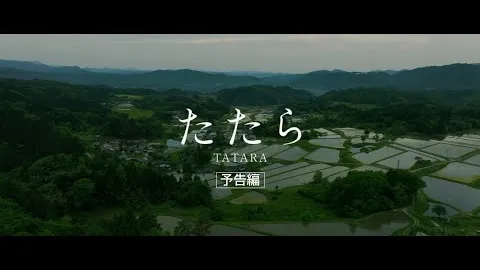
Both our film before last and our previous film won awards at international film festivals in succession, and this new film will also be entered for international awards, starting with the Berlin International Film Festival in November through September next year. Whether it will win is uncertain, but we are looking forward to it.
So why does our company make films? The reasons are as follows.
Employee Training
The first purpose is employee training. Employee training has two meanings here, the first of which is improving video production skills.
(1) Improving video skills
Because our company undertakes video production such as commercials and promotional videos for businesses,
we must develop a variety of talent responsible for production, including scriptwriters, producers, directors and production managers. Mid-career hires may have experience, but for new employees, while it is common to learn on the job, out of courtesy to our clients the production site should be staffed by professionals.
We can’t exactly have someone wearing a “trainee” badge on a shoot.
So our approach is to create video production sites in-house and conduct employee training there.
In the past, whenever an acquaintance or friend got married, we would produce their “wedding video” free of charge.
We would listen to the wishes of the bride and groom before the wedding, decide what kind of concept and filming to do, and screen it at the wedding.
Since a wedding is a real venue, we could also gauge the reactions of the guests.
In this way, before taking part in actual production sites for clients, newcomers were taught the basics of video production through “wedding videos.”
However, as everyone knows, weddings do not occur on a regular basis.
What we came up with instead was filmmaking.
Although it is once every two years, we create a filmmaking site and use it to train newcomers.

The other is
(2) Team building
.
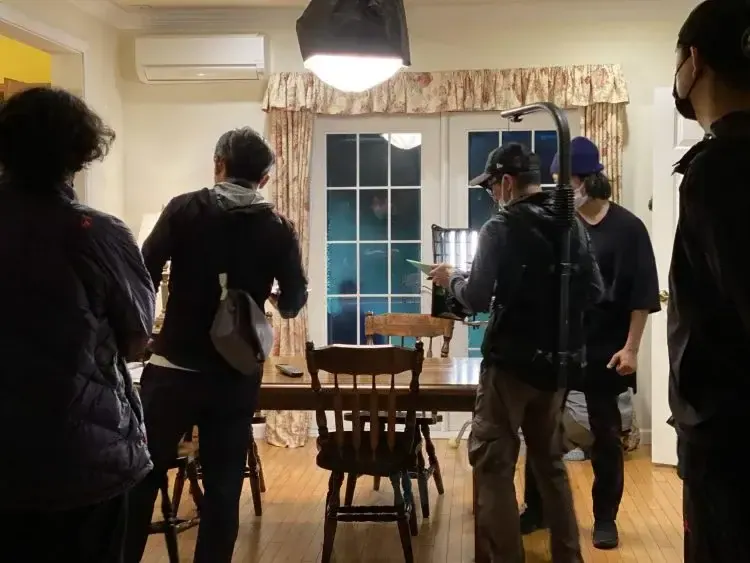
All of the work at the core of this filmmaking is handled by newcomers. Examples of core work include screenwriting, directing and production. Technical staff such as camera and lighting are requested from senior colleagues.
This mix of newcomers and senior staff is extremely important.
Newcomers can learn a great deal from their seniors, and precisely because of the seniors’ support, a highly polished work can be expected even though the core is handled by newcomers.
On the other hand, it also has an educational effect on the senior staff.
Senior staff are highly experienced, but there are many cases where their accumulated experience hinders innovative thinking.
Here is an example from this filmmaking project.
Even though it is filmmaking, there is no sponsor, so the budget is limited.
Unless you think in a balanced way about where to spend and where not to, you will go over budget.
While adjusting the budget for this film,
we needed to keep costume costs down.
The budget had been set at 300,000 yen, but it looked like it would inevitably cost 700,000 yen,
an overrun of 400,000 yen. When we asked the senior staff member in charge of production for a breakdown,
it consisted of the fee for the stylist handling the costumes,
the rental fees of the costume rental company,
and the cost of purchasing other costumes not available for rent.
Of course, this is naturally the general breakdown of costume costs.
When we considered how to reduce this budget,
one of our newcomers came up with the following proposal.
“I’ve picked out all the costumes on Mercari. The total cost is 120,000 yen. I have one request: some of them are new items with tags still attached, so please tape the tags down and don’t remove them. That’s because we’re going to list them on Mercari again. If we resell them for 130,000 yen, we’ll make a 10,000 yen profit...”
The senior staff were speechless (lol).
Naturally, the idea was adopted.
In fact, mixing newcomers and senior staff often leads to friction, but when they come together, major innovation is more likely to occur.
We often hear of senior staff crushing their subordinates (newcomers). Many subordinates also hesitate to make suggestions to their seniors.
In this in-house project, through proper facilitation, senior staff learn how to develop their subordinates and draw out their potential, juniors learn how to communicate with their seniors, and at the same time, both learn how to build a team.
Social Contribution
Many companies engage in activities related to social contribution.
Our company has also long considered and carried out social contribution activities,
but we believe it is more efficient and effective to approach social contribution through our areas of expertise.
While making this film,
we met with members of local governments in Shimane to request filming cooperation and pay courtesy visits.
However, even as we met with them, we sensed that something felt off.
So when we asked, “Is there anything you are concerned about?”
they told us that almost every film company eventually brings up the subject of money.
“Making this film will promote your area. Could you therefore provide XX yen?”
Naturally, we told them that we would not request any money and that simply being allowed to use the locations was more than enough.
With that, they finally seemed relieved. (lol)
Since the main point is social contribution, not promoting Shimane,
this is a natural stance for our company.
The theme of this film
is not primarily a PR video conveying Shimane’s culture (as mentioned above),
but a depiction of the love between parent and child.
In particular, we included the message that “society will not become better unless parents change their preconceptions.”
We made it based on the hypothesis that “by changing parents’ preconceptions,” everything from small troubles to big troubles (e.g., war) might be avoided.
We therefore plan to enter it in film festivals around the world so that people worldwide can see it, and also to have it screened by various environmental and educational organizations.
This may be a small initiative, but we believe that it is precisely the accumulation of such small initiatives that has a positive impact on society.
Considering New Businesses
In fact, we are also researching the monetization of video content through this film.
Traditionally, television content (dramas and variety shows) has relied on advertising revenue,
and films have relied on box office revenue.
However, over the past few years, revenue models have been changing rapidly.
Television and film are shifting to online viewing and to revenue models such as PPV.
Even so, television and film production sites remain old-fashioned, with poor revenue structures.
As content businesses such as video change,
we will keep the details secret, but this filmmaking project is moving forward with the aim of creating a new revenue model through filmmaking.
Social contribution and monetization, as described above, may seem contradictory at first glance,
but we believe that this contradictory thinking is what generates the revenue structure mentioned above.
By exploring and building the integration of social contribution and monetization,
we hope to bring out the true appeal of video production.
Text: Hiroshi Ashida