AI: From research to everyday tool
The basic form of AI is the “LLM,” or large language model. This is an AI mechanism that has read vast amounts of text and learned “patterns of language.” BERT and GPT-2, which appeared around 2018, were the first examples of LLMs and were used mainly for research.
What evolved from there was the “GPT” series, the representative LLM models. Text generation advanced greatly with GPT-3 in 2020, and when it was released as ChatGPT at the end of 2022, it suddenly came within reach of general users.
Today, the latest models such as GPT-4 and Gemini have appeared, and they can even handle images and audio.
First, research support. This has two aspects.
One is summarizing and organizing existing materials.
The other is having AI carry out the research itself, such as searching for reference cases, papers, and articles.
This greatly reduces the problem of “spending too much time on research.”
Use in the creative field has also begun.
First, copy generation. With AI, it has become possible to produce multiple ideas for advertising copy and social media posts in a short time.
Next, design. By using generative AI to produce mood boards, rough drafts, and design comps for actual use, discussions on direction move faster, and it has even become possible to deliver actual designs.
In this way, major benefits have emerged for our Strategic Planning service.
These include shorter work times, a lighter burden of document creation, the ability to produce multiple proposals at once, and making it easier for even newcomers to produce a certain level of output.
On the other hand, the risks cannot be ignored. Copyright issues—the possibility that generated content includes someone else's material without permission.
Information leakage—the risk that confidential information entered remains in the cloud.
Inconsistent accuracy—answers that vary even for the same question, and factual errors.
Ethical concerns—the possibility that AI reproduces the biases it has learned as is.
In other words, understanding both the convenience and the risks, and thinking about how much to entrust to AI and what people should handle, has become a key to using AI.
Our approach to using AI
Whenever we carried out strategic planning, we always faced challenges.
Because a small team handles a wide range of work, sharing and accumulating knowledge is difficult.
Document creation and research take time, limiting the time we can devote to our real work of planning and creative.
On top of that, it is difficult to allocate sufficient resources to education and talent development.
Our starting point was whether AI could support us in this situation.
For example, when creating a strategic plan, it takes time to find past reference materials, and the format and structure have to be devised from scratch. I think it is often the case that we are so busy organizing information that the crucial work of generating ideas gets put off.
By entrusting this part to AI—presenting reference proposals and generating formats—we wanted to be able to lay the groundwork in a short time.
Strategic planning also requires the know-how of our proprietary “Strategic Framework: 6e.”
“6e” provides the fundamental information for strategic planning and runs to as many as a thousand pages.
So, by using AI to ingest the “6e” information and past materials and adding new requirements (prompts), it becomes possible to carry out up-to-date strategic planning.
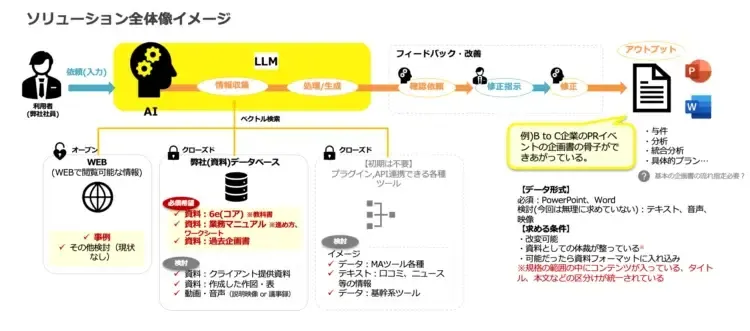
The overall solution is illustrated in the diagram below.
Past proposals and manuals are accumulated in a knowledge database, and AI searches, summarizes, and restructures information from it.
The deliverables are output in formats that can be used immediately in the field, such as PowerPoint and Word.
In other words, it is a mechanism that supports the entire flow seamlessly: “data accumulation → AI utilization → turning it into usable materials.”
The key is closed data.
Many people ask “GPT” for strategy advice, but that is merely what has been gathered and aggregated from the internet.
However, by building on our own proprietary know-how and combining it with open data,
evidence-based output that “works” becomes possible.
Future expectations and challenges
AI has “weak areas” and “bad habits.”
One is a phenomenon called “hallucination,” in which it produces plausible-looking falsehoods.
Next is output that lacks accuracy.
Even if the text is well-formed, the content can be inaccurate.
And it does not truly have the “ability to think” as humans do. It is merely predicting and producing patterns of words.
What matters here is the question: “Can these weaknesses be compensated for by AI or systems?” Or “Must humans always take responsibility for them?”
There is still a considerable gap between today's AI and the “AI that can do anything like a human” that we imagine.
Current generative AI is only at the stage of “producing plausible words and images in response to specific inputs.”
Beyond that lie concepts such as “artificial general intelligence (AGI)” and “artificial superintelligence (ASI),” but we have not even reached AGI.
In other words, we need to think about how to work with AI based on the premise that “today's AI is not all-powerful.”
The ability to understand the emotions of customers and consumers, and making final decisions on concept-making and expression.
Also, the perspective of judging whether something is ethically and socially appropriate.
And communication that builds relationships of trust with teams and clients.
I believe these cannot be replaced by AI and are uniquely human values.
While developing Strategic Planning AI, how should we deal with these “weak areas” and “bad habits”?
What should our staff education curriculum look like?
We believe that by pursuing these questions carefully, our services will evolve even further.
Text: Sayaka Kaizu