
The self-taught corporate strategies rampant in Japanese companies
Executives who don't study leave their employees stranded
We often hear the term “corporate strategy,” but what exactly is “strategy” in the first place?
It is originally a military term. When used in corporate management, it means having a perspective that looks at the broad picture of society, the economy and industry conditions and considers the company's direction and corporate activities over the medium to long term.
If a company is a ship, corporate strategy is, so to speak, its nautical chart and compass. If you set sail with nothing from the start, you could lose sight of your destination along the way. And if you are unlucky enough to run into a storm, the ship, far from making it to land, may well sink.
Likewise, if a company has no strategy, it can only respond haphazardly to changes in its environment, and in the worst case it ends up “at the bottom of the sea” along with its “crew,” the employees.
I have seen unfortunate people such as executives who took their own lives as their companies faltered and debts piled up, and executives who fell ill from the stress of poor business performance. I was made vividly aware of the lesson that “business failure is a matter of life and death.”
Facing these facts and deepening my research on management, I discovered that there is a common pattern among companies that go bankrupt, companies that stagnate and companies whose growth stops. That is, every company in difficulty lacked the “knowledge” needed for a corporate strategy capable of responding to changes in the environment.
Corporate strategy is basically formulated by executives themselves. The executives of struggling companies were simply not capable enough, nothing more.
More than 99% of companies in Japan are small and medium-sized enterprises. Their executives often started out as sole proprietors and hold the idea that “running a company = doing things my way.”
That may be fine if you work alone, but as you take on employees and grow to some extent, you reach a point where you can no longer run the company on your own ideas and whims alone. If you fail to notice this and continue the way you did at founding, then when you fail, it affects not only you but also the lives of your employees and their families.
In recent years, even Japan's “ultra” top-tier companies have conspicuously lost their way. This is evidence that Japanese executives lack solid strategy.
Despite many real-world examples, such as the revival of JAL by Kazuo Inamori, founder of Kyocera Corporation, there are still companies finding themselves in difficulty, which makes me wonder whether executives are properly facing the important theme of “corporate strategy.”
I think the individual reasons vary, including ways of thinking particular to the Japanese, industry characteristics and each company's unique history, but I believe the major problem in the management of Japanese companies lies in executives' “success experience bias.”
“Success experience bias” is a state in which executives believe their own corporate strategy contributed most to past successes and, trapped by this belief, become unable to take on new strategic approaches.
Take, for example, an executive whose company's product sales were a success. The product he developed sold explosively and has continued to this day. He firmly believed that the success was the fruit of his own product development and sales abilities.
However, sales gradually began to decline. The reasons were varied: the product had fully penetrated the market, similar and low-cost products appeared, and it became outdated as more advanced products appeared.
Because the executive was convinced that “the reason for success lies in the methods I have used all along,” he would not listen to any advice from those around him and kept focusing on product development and sales with the same thinking as before. Perhaps out of impatience, he kept failing, and eventually sales fell to half of their peak.
Yes, executives of this type tend to fail. There is no guarantee of continued success forever, yet they only look at what is right in front of them.
Once executives are affected by “success experience bias,” they become confused when faced with a situation where their past methods no longer work, and they are left at a loss and lose their way. This executive, who believed he had succeeded through honest hard work, ultimately ran out of strength at this point.
Excellent executives learn and find the cycle of success
Executives who have acquired knowledge of corporate strategy do not take this approach.
First, at the start, they think about how to develop the business and put it into action. If they succeed, they properly analyze the reasons and identify the principles of successful sales. If they fail, they simply identify the causes of failure, make improvements and try again.
If they achieve success and the company grows, they promptly and accurately grasp the driving force behind that growth. Looking back on the company's growth, they objectively pursue the causes of success while adding a somewhat skeptical perspective: Was it the trend of the times? Did a major client simply take a liking to them? Was it chance? If it was inevitable, was it because the product or service was good? Or was it a combination of these?
Through this kind of analysis, they find out what factors brought about the success. What is discovered as a result is the company's “strength.”
However, relying solely on that “strength” is dangerous. In aiming for the next stage of growth, including the growth process and responding to crises, your “strength” alone will eventually be unable to solve the various issues that arise.
Executives who have thoroughly analyzed and identified the principles of success do not get carried away by their current success; they carefully work out plans toward new success and find the right direction, for example by researching the next trends that will sell or setting up a product development section in-house.
This is “making a compass so the corporate ship doesn't run aground.” In this way, excellent executives create a cycle for repeating success.
Many Japanese executives achieve temporary success through effort and ideas, but, for better or worse, they rarely look back, and they tend to stare straight ahead without looking sideways.
This is the point I most want to raise as a problem, and it is the “success experience bias” mentioned above. Executives swept along by this bias end up “not seeing the forest for the trees,” losing sight of the big picture and charging off in the wrong direction.
In short, it is essential for executives to dig deep into their own strengths and the strengths of their services and products, while not relying on those alone, and to view corporate strategy as a whole holistically (comprehensively). Said like that, it is really quite simple, but a great many executives do not know this common sense.
Why I think executives need a license
Another problem, alongside “success experience bias,” is executives' low “strategic literacy,” which in this case means management knowledge and the ability to use it. The current reality is that a lack of “strategic literacy” leads to formulating low-level corporate strategies and choosing the wrong partner companies, ultimately resulting in failure.
A company's partner companies mainly refer to firms that support corporate management, such as consulting firms, advertising agencies, licensed professionals like tax accountants, and IT vendors.
Many companies try to grow and increase sales by drawing on the strength of these partner companies. However, handling these companies does indeed require “strategic literacy.” In other words, if you cannot make good use of your partner companies, management falls into disarray.
The ability to handle partners is one aspect of “strategic literacy” that is important for executives.
Based on my own experience as well, I believe the quickest way for executives to develop their own “strategic literacy” is to take the initiative to attend business school and obtain a qualification such as an MBA.
MBA stands for “Master of Business Administration,” which translates into Japanese as “keiei kanri-gaku” (business administration). If you properly study business administration and master its techniques, your ability as an executive will improve dramatically. A business school is, by nature, a place for developing management ability.
To obtain an MBA, you not only study the essentials indispensable to corporate management across the board, such as marketing, management, finance, organizational behavior and HRM (Human Resource Management: an HR approach that comprehensively manages not only individuals but the organization as a whole through education and training), but also, through case studies, continuously train yourself by asking, “What moves would I come up with?” while learning the various strategic cases of other companies.
In other words, you thoroughly learn comprehensive knowledge of management activities while repeating mock battles.
However, there are several major problems here.
First, there are many cases where executives do not trust the MBA.
When I visit clients, I sometimes hear, “We have an MBA at our company, but he's not much use.”
Certainly, even if someone obtains only the qualification, it is natural that they are not useful if they lack the abilities required of a member of an organization, but that has nothing directly to do with the MBA.
So why does it lead to misunderstanding and prejudice about the MBA?
It is true that there are businesspeople who obtain an MBA, imitate Western-style presentations and proudly show off their logic, but cannot execute.
Doesn't this spread the view that “MBA holders are useless” and give executives an allergy to it? Perhaps because of this, Japanese executives and candidates for leadership have become less keen on obtaining MBAs.
Even at the business school I attended, there were cases where I thought prejudice was understandable.
That was a group of people who work at large companies and seek promotion by earning a degree. They should have graduated from reputable universities, so they are good at studying.
People of this type just need to get the degree, so they are not keen on study premised on practical application. They earn their MBA by making full use of memorization, study techniques and armchair logic, and then graduate.
I have no way of knowing what became of them after graduation, but I can guess that these are probably the people who become “all-theory types” and, as a result, are criticized by executives.
An MBA is, after all, a qualification for studying knowledge, information and know-how about management and applying it in practice, and those who can make full use of it are “true MBA” holders. In short, the difference is whether or not you studied in a way you can use in management. At overseas companies, it seems there are cases where, without a degree at MBA level or higher, you are not only passed over for executive promotion but not even invited to meetings.
The difference is also clear in a survey of attitudes toward study among high school students in Japan, the U.S., China and South Korea.
Among Japanese high school students, the overwhelming expectation for the future is to go only as far as a four-year university, and while over 50% of American high school students aim “to become a leader,” the figure in Japan is in the single digits, far behind China and South Korea as well. This suggests that Japanese people have little desire to study in the first place and hardly any wish to become leaders.
Given this climate, Japanese businesspeople hardly study at all after graduating from university.
They may think that once they get into a good university and join a top company, they are set for life, but in today's Japan, where even lifetime employment is in doubt, it has already become clear that this idea is an illusion.
Yet there is a tendency to treat joining a company as the final goal. Once they are hired, all they think about is surviving successfully within the company. In Japan, few businesspeople aim to become leaders—that is, executives or senior managers—and apart from those who need special qualifications and a small number of ambitious people, most stop studying once they have achieved the goal of getting a job at a top company.
But is that really acceptable?
Executives in Europe and the United States know how important it is to hone management skills through higher education such as the MBA, and they have put this into practice to get where they are today.
The Japanese of the past had diligence that spared no effort, an honest and sincere character, intellect, and the wisdom and technology to create high-quality products. There are many examples of Japanese ideas and technological capabilities that shocked the world, such as Sony's “Walkman,” Nichia Corporation's “blue light-emitting diode,” and Toshiba's “flash memory.”
In the era when Japan grew after losing everything in the war and going through high economic growth, wisdom and technology, effort and grit were enough to get by. The executives of that time had a track record of taking on the world with their unique intuition, technology and drive. However, that era may now be drawing to a close.
Since the number of young people who even want to contribute to their company as leaders—let alone as executives—or who want to learn and aim higher is small, it is only natural that fewer people who actually rise to the top emerge in Japan than in other countries.
If we keep thinking that “Japan is the top of Asia” forever, there is no future. Elites in ASEAN and neighboring countries such as China, South Korea, Singapore and the Philippines speak English as a matter of course when they go into business negotiations.
Japan, on the contrary, has become inward-looking, and I hear that the rate of studying abroad has fallen compared with before. That alone shows how unlikely Japanese people are to become international talent. The gap between ASEAN countries and Japan is widening year by year, and I predict that Japan will eventually become a “higher-education laggard” even within ASEAN and that Japanese corporate management skills will steadily decline.
In the future, if Japanese executives want to run businesses that do not fall behind the world, they themselves must pursue higher education such as an MBA and acquire the ability to devise corporate strategies.
In this respect, the difference in eagerness to learn between Japanese and overseas executives is obvious, and Japan has already fallen behind.
It is no exaggeration to say that almost all overseas executives hold MBAs. Like English conversation, the MBA exists as a “common language” and “common understanding” among executives and is becoming a prerequisite for becoming an executive or a candidate for leadership. The MBA is now something like a driver's license for executives.
Many of you may not be familiar with it, but in recent years overseas there has been a surge among executives in obtaining the Doctor of Business Administration (DBA), a degree that sits above the MBA.
If an MBA is like a standard driver's license, a DBA could be compared to a commercial or heavy special vehicle license. At globally operating companies, the DBA may eventually become an essential requirement for executives who aim even higher.
Japan has something similar, the doctorate in business administration (Ph.D.), but despite both being doctorates, the substance is different. Ph.D. stands for Doctor of Philosophy, and in the field of management in particular it is called a Doctor of Philosophy in Business Administration or a Doctor of Philosophy in Management. It is a doctorate derived from philosophy, with a strong research orientation, which makes it very different from the DBA, which focuses on practice.
Unless Japanese executives not only hone their personal skills but also pursue degrees as proof of them more actively, they will eventually fall behind other countries.
Why Japanese Business Schools Fall Short
So far I have discussed the importance of the MBA from various angles, but now let me share one more surprising fact about MBA education in Japan.
Even without studying abroad, there are many universities and affiliated business schools in Japan where you can earn an MBA. There appear to be thirty-some schools at present, yet astonishingly, only three of them have received formal accreditation from international accreditation bodies such as AACSB, the international accreditation organization for MBA education (as of February 2017).
Those three schools are Keio University, Nagoya University of Commerce & Business, and Ritsumeikan Asia Pacific University (APU). Several other universities, such as Waseda University and Hitotsubashi University, are said to have reached a level close to international standards, but they have not yet received formal accreditation. Frankly, I too was surprised that such well-known universities in Japan were still unaccredited.
Even if someone calls themselves an “MBA holder,” only those who have studied at a school that meets international quality standards can proudly say, “I earned an MBA!”
Furthermore, the name of the MBA degree is not standardized in Japan. I will omit the university names, but there are, for example, “Master of Business Administration,” “Master of International Management,” “Master of Management of Technology,” and so on; I found no fewer than 11 different names from my own checking alone.
Moreover, since these schools have not received international accreditation, even if the degree is called an “MBA,” what is taught does not reach the level of a formal MBA.
I do not know the real reason why these are called “MBAs,” but the current situation in Japan is that “self-proclaimed MBAs” hold sway, and no one questions it. When I asked people involved with overseas MBA schools about this situation, they said, “It would not be surprising if they were sued.”
Here is an actual example.
A certain job seeker, when taking the recruitment exam for a foreign-affiliated company, explained the MBA they held. That school was a Japanese MBA school without international accreditation.
Despite their desperate efforts to make an impression, the person's résumé was reportedly returned as “not worth evaluating.” Several of my friends who completed the same domestic MBA were deeply disappointed when they learned this. When they vented their anger at the school, it turned out that neither the professors nor the administrative office were even aware of this fact.
Furthermore, many professors in Japanese master's programs in business administration are researchers who came through the Ph.D. route, and few tend to have practical experience in business strategy. As a result, classes become highly academic and drift further and further from real business.
Confronted with this reality, I can understand why people would not want to trust the MBA. And if there are MBA holders in a company who are actually of no practical use, it is understandable that executives' and senior managers' distrust of the MBA turns into conviction.
Choosing the Wrong Partner Companies Can Ruin a Business
Can Partner Companies Truly Be Partners to a Business?
It hardly needs explaining, but companies have several partner companies that support their business activities.
Examples include consulting firms that plan and design corporate strategy on behalf of companies; advertising agencies that work on companies' products and services, and even recruitment, through producing advertising for media such as TV commercials, newspapers, magazines, and the web; and IT vendors that build companies' core systems and IT infrastructure.
Beyond these partner companies, there are also partners that support companies’ business activities from the sidelines using professional qualifications, such as tax accountants, lawyers and patent attorneys.
What I want to address here is the reality of partner companies and how to choose them. Three are especially important: consulting firms, advertising agencies, and IT vendors. This is because, depending on how you engage with them, these partner companies can have a major impact on a company's performance.
Top-tier companies with ample funds set up departments equivalent to these partner companies and scout talent to keep in-house. Even so, when they run a commercial, for example, they surely rely on major advertising agencies.
And most companies, except for “wealthy companies,” end up commissioning the partner companies they need according to their budget, timing, issues, and so on.
However, partner companies do not possess any definitive corporate strategy know-how for supporting their client companies either. So how are they able to continue existing as companies’ strategic partners?
The reason is that the purpose of partner companies is to generate profit solely within the area they are responsible for. They can provide some advice as a brain trust, but taking a bird's-eye view of the entire industry and formulating corporate strategy is not the role of partner companies; it is the job of the executive.
Well-known partner companies attract excellent talent. Major firms in particular have a track record of earning profits by supporting top-tier companies, so newcomers form “teams” with their seniors to meet companies’ requirements.
Training in such cases is close to an apprenticeship system in which, like Japanese craftsmen, one “steals the techniques,” making it quite difficult for a single senior employee to develop many juniors.
Since what companies require of these “teams” differs case by case, once they have a certain level of shared know-how, the rest is simply a matter of succeeding through on-the-ground responses.
Through this repetition, individual experience grows, but I suspect they are not sharing the know-how learned across the organization to raise the skills of the company as a whole. As a result, the quality of employees tends to be uneven. That is my conjecture.
There are also partner companies that grin when they find a client's shortcomings. When they find multiple problems in a company, they solve just one and profit from it, but because the other causes remain unresolved, the client company's performance never improves.
When that happens, it is natural to consult the same partner company you used before. If they then point out a new problem and solve it, they can profit again and again. In fact, I have seen many cases of partner companies running their business this way.
The Reality of Consulting Firms
When I visit companies to support their corporate strategy, I often hear things like, “We used another consulting firm before and it was a failure.” Such stories are nothing new.
I have wondered since my days working at an advertising company, “Why are consulting firms so disliked?” So even now, whenever the topic comes up, I make a point of asking for details.
The reasons are many and varied, but let me give one example. This is the story of a certain railway company.
While talking with the corporate planning office, I was shown the management plans that previous consulting firms had prepared. There were two plans, each proposed by a different firm. Both had been prepared by major consulting firms that everyone knows. The plans were thick, probably about 300 pages each.
I flipped through them, and frankly I couldn’t help sighing, “What terrible content.” I have prepared more planning documents and proposals than I care to count since I was a newcomer, so I can tell the quality of a document after reading just a few pages.
The main reason I found the management plans so terrible was that they had clearly been written by several people; there was no overall consistency, and the content at the beginning did not connect with that in the latter half.
Probably because the work had been divided up, each author’s own “color” came through, their arguments differed subtly, and because each competed to write their own part at length, the documents had grown to an abnormal volume. Even if one took them at face value and tried to put them into practice, it seemed utterly impossible to realize them.
The person in the corporate planning office had also noticed the lack of consistency and lamented, “These are simply unusable.” When I asked how much these management plans had cost, I was told that one cost 100 million yen and the other 30 million yen.
Since this was a large company with plenty of money, it may have been settled as “a failure this time,” with some minor disciplinary action for the person in charge, but for an SME it would undoubtedly have been a severe blow.
What is truly frightening, however, is the case where a company trusts a management plan of this quality and puts it into practice. If it pours large sums into something that cannot possibly succeed, the losses would be immeasurable.
Thinking about that sent a chill down my spine. Since the damage was kept to a minimum, in a sense the corporate planning office’s decision to put a stop to it was the right one.
Recently, I was also asked to design the corporate strategy for a company with annual sales of around 20 billion yen. At that size, consulting firms have naturally been involved before.
When I asked about it, they said, “Well, we commissioned a major consulting firm for about 30 million yen, but the result was completely useless. The only output was ‘Your strength is your people.’ Seeing that, even our president was furious.”
There are cases where companies have made good use of consulting firms or where proposals have fit well and improved business performance, but failures like this also frequently occur in reality.
Some time ago, I spoke with several people to learn about the reality of consulting firms. One of them was a professor at the MBA school I attended.
Before teaching at the school, he had worked at a major consulting firm. So I asked him frankly what actually goes on at consulting firms.
Major consulting firms hire highly educated people to begin with. He said they also have a systematic training program for new employees, but there are no unified basic rules or know-how for formulating management plans.
After training, newcomers are taught through practice by senior employees, but since everyone is inherently smart, education is apparently centered on “learning on the job.”
As a result, because the guidance is individual, the management plans produced depend on each person’s ability: talented people produce high-quality management plans, while those without aptitude produce poor ones.
In short, even at major consulting firms, the quality of consulting varies depending on the person in charge.
There is another phrase that executives who dislike consulting firms often repeat: “They can formulate strategy, but they won’t teach us the tactics.” This carries a very deep meaning.
There is hardly any need to explain the difference between strategy and tactics. No matter how excellent a strategy is, a strategic design that does not take into account tactics, that is, methods of execution, ends up as mere theory. In other words, it is “all idealism and not realistic.”
Consulting firms earn their revenue strictly by designing strategies. Moreover, the higher the fees they can charge, the more they are evaluated as having accomplished excellent work.
To put it in extreme terms, all they need is the ability to produce proposals and plans that look like they can be sold for a high price. What happens on the ground does not concern them. That is because providing such hands-on support would make it hard to wrap up the engagement. And of course, they likely have almost no on-the-ground experience, since they do not actually work at that company.
And so people who don't really know the front lines, with widely varying abilities, put together armchair theories and assemble them into a single plan. That is the true nature of an expensive strategy design document.
Of course, among my acquaintances and colleagues there are many excellent management consultants who deliver results worth their cost. Even so, dispelling the negative image that leads executives to say such things is an important issue that the consulting industry as a whole must reconsider.
So how can you choose an excellent consulting firm while avoiding waste as much as possible?
Ultimately, the only way is for executives and senior managers to enhance their own knowledge and skills and acquire the ability to properly formulate and execute corporate strategy themselves. That is the executive's job. Companies fail because they hand everything over to other firms.
If executives raise their own literacy in corporate strategy, they can then simply ask a consulting firm for partial support only where it is needed.
If anything about the support seems even slightly off, you can stop there and have it corrected, or switch to a different firm. With a sharp eye for the support you receive, you can achieve your corporate strategy while preventing damage from spreading and keeping costs low.
The Troubles Facing Advertising Agencies
While I was writing this book, several major incidents occurred that shook trust in the advertising agency industry.
I am not defending them, but now that I have started my own company, my firm is sometimes asked to formulate strategy for advertising agencies themselves, so I know a fair amount about the behind-the-scenes situation and can sympathize with the struggles of advertising agency executives.
What are the troubles of advertising agencies? They are declining cost-effectiveness and the inability to keep up with the diversification of media used to deliver information. Let me explain in a little more detail.
Normally, when a client company wants to run an advertisement, an advertising agency handles everything from producing the ad to placing it in one package. The fact is, however, that the very word and concept of “advertising” is becoming out of step with the times.
As the word suggests, advertising is about broadly announcing a company's products and services to consumers. In the past, people encountered products and services by seeing them directly in nearby stores, through salespeople, or by word of mouth. In addition, companies with budgets grew their sales using mass advertising in newspapers, radio, magazines, and so on.
Then, during the period of rapid economic growth from the late 1950s (the Showa 30s) onward, it was the spread of television that helped large companies grow even larger. It was an era when family and friends gathered in front of the TV, and the next day everyone at school or work would excitedly talk about what they had watched.
A single successful TV commercial could even give birth to a listed company; the influence of advertising was enormous.
Today, however, due to factors such as more overtime, more dual-income households, and the diversification of entertainment beyond television, family members lead separate lives even under the same roof.
Furthermore, with the development of the internet and the spread of SNS (social networking services), good products and services now spread through word-of-mouth information.
Likewise, “exaggerated advertising” is quickly exposed as a lie and the exposure spreads. There are also bad cases where people believe plausible-sounding false rumors to be true and spread them further. If there is a failure or mistake, it immediately sparks a firestorm on social media, and companies are often knocked down so hard that they cannot easily recover.
As a result, companies begin “self-regulation” with safety first, and the impact of advertising weakens. Another major factor is that people's incomes have been steadily declining, so they no longer spend money on things.
For these various reasons, companies are reconsidering whether advertising itself is meaningful, and more and more are working to optimize or cut their advertising expenses.
Having said all this, the truth is that corporate advertising budgets have actually been increasing since the “Lehman Shock.”
A simple comparison is not possible due to factors such as rising placement costs, but advertising expenditure itself is higher than in the “bubble” era. While some companies are cutting their marketing and promotion budgets, others are investing heavily. Especially notable is internet advertising spending. Eating into TV placement costs, internet advertising expenditure has continued to rise steadily since the mid-2000s.
Mass advertising on television, newspapers, magazines, and the like (*mass advertising refers to mass media such as TV commercials, newspaper ads, magazine ads, and billboards) has declined, but only the direction of advertising has changed; new advertising design models that did not exist before have emerged, such as guiding people from mass advertising to the web, and companies' methods of designing advertising have changed.
However, advertising agency executives find it hard to make a move. Herein lies the weakness of traditional advertising agencies.
The first reason is that a scramble has begun for a fixed pie targeted by mass advertising, and the number of companies that can afford mass advertising has become limited.
One cause is the decline in TV viewing time mentioned earlier. Television is watched frequently mainly by middle-aged and older people, but among younger generations in their 30s and under, smartphone use has overwhelmingly increased compared with TV. The amount of time people spend with media has not changed much from the past, but where that time goes has changed dramatically.
Furthermore, because the incomes of young people are not growing, they are kept busy with overtime and come home late; even if they marry, as dual-income couples they are in no position to have children, and marriage itself is becoming difficult.
They have no time to watch TV during the so-called “golden time” from 7 to 9 p.m.
Even for automobiles, one of Japan's key industries, more and more people in major metropolitan areas (though not in rural areas) cannot afford a car or consider one unnecessary. If fewer people buy things, corporate sales will only keep declining. It is really quite simple: if the population does not grow due to the declining birthrate and aging society, the number of buyers is limited no matter how much you advertise.
Another weakness is the lack of know-how in producing online advertising.
In recent years, there has been a sharp increase in emerging companies that are better at producing online ads than the advertising agencies that have traditionally created TV, newspaper, and magazine ads.
Mass advertising online can be produced more cheaply than TV commercials and the like. As a result, mid-sized advertising agencies that stuck to the old ways have been put in a difficult position.
In addition, the cost-effectiveness of TV commercials can basically only be measured roughly by comparing viewer ratings with sales, whereas with online advertising, where data analysis has also advanced, it is becoming possible to measure detailed cost-effectiveness through methods such as tracing customers' browsing histories. Perhaps for this reason, some companies have begun to question running TV commercials that cost enormous sums.
Currently, the products and services featured in commercials aired on TV are said to number about 7,500 brands per year. Multiple advertising agencies are fiercely competing over just these 7,500 brands.
In marketing there is the term “red ocean,” describing a bloody battle as the competitive environment intensifies, and the advertising industry has truly become a “sea of blood.”
There are also problems with how advertising agencies produce advertising. When an agency receives an advertising order from a client, it outsources most of the planning and production work, such as various market surveys and commercials, to external vendors.
What happens then? The know-how of “producing advertising” does not accumulate within the advertising agency itself, and the “strength” of production capability passes to the external vendors.
Major advertising agencies end up with functions centered only on sales, and their in-house production capabilities weaken considerably. When new advertising agencies that are also skilled at IT-related production enter the market, the agencies have no choice but to compete with each other on sales service toward client companies.
To develop new sales targets, advertising agencies are also expanding their sales activities to small and medium-sized enterprises, which they had not paid much attention to before.
However, because SMEs have had little experience dealing with major advertising agencies, they sometimes seek support not only for advertising but even for corporate strategy. I deliberately bring this up because such cases occasionally occur around me, and almost all of them fail.
As I will explain in Chapter 2, corporate strategy has six stages, including Marketing, Management, and Operations.
Marketing, one of these, is classified into the 4Ps (Product, Price, Promotion, Place). Of these, Promotion is further subdivided, and advertising plays only a very small part of it.
Viewed from the perspective of corporate strategy activities as a whole, advertising is merely one element, and advertising alone cannot possibly solve management issues.
Even large advertising agencies do not have the know-how to support corporate strategy, so if you casually ask them for corporate strategy support, you will end up in serious trouble.
The Astonishing Alchemy of IT Vendors
Finally, let me explain the current situation of IT vendors as corporate partners.
Once companies reach a certain size, they begin introducing IT systems in pursuit of efficiency. Starting with small-scale accounting systems, the scale gradually expands to systems with diverse purposes, such as sales management and customer management.
In recent years, software itself has evolved remarkably. There are packaged software products and inexpensive options that use cloud systems. There is also a method called “scratch” development, in which a system is built from the ground up to fit a company’s business structure and needs precisely.
However, implementing IT systems is also accompanied by failure at a considerable rate.
IT orders range from several million yen to tens of millions or even hundreds of millions of yen, so the costs are by no means trivial.
In general, costs are calculated from the “man-hours,” i.e., the processes, number of people, and number of days required for system development, but this depends on what the vendor claims. Moreover, depending on the development content, it can take anywhere from six months to several years, requiring both time and money.
Yet quite a few systems turn out to be unusable once completed, and all that effort simply “goes down the drain.” In some cases this has even led to lawsuits, and it can have a serious negative impact on corporate management.
So why do IT solution implementations fail like this?
The reasons are that the ordering company does not know how to work with IT vendors, and the IT vendor receiving the order cannot understand the company’s needs. Because of these two factors, IT implementations often fail.
Let me start by explaining the problems on the company side.
It would be a different story if the company had employees with knowledge and experience in implementing IT solutions, but most companies, especially SMEs, have no experience implementing IT solutions, so they first struggle to choose an IT vendor to order from.
Here, companies face three broad choices.
The first is the “scratch” pattern mentioned earlier, building from the ground up. If you choose this, it starts with interviews to organize business processes and requirements, so it is costly and the development period is long. Since you are creating a program that never existed before, the risk of failure is also high.
The second is the pattern of purchasing packaged software. If you purchase software that matches the company's issues and needs, it is relatively inexpensive and less likely to fail. That said, while accounting software and the like may be fine, a core-system-class package can cost hundreds of millions of yen to implement.
Packaged software can usually be “customized” to fit specific needs. However, customization is charged separately, and it is outrageously expensive. One often hears stories of companies that thought they had bought packaged software cheaply, only for it to end up unbelievably expensive after customization.
Lastly, there is the pattern using the “cloud,” which has increased rapidly in recent years. Until then, it was standard to install and use systems based on large computers in-house. Most of the scratch-built systems mentioned earlier are of this type.
“Cloud” literally means a cloud in the sky; these services are managed centrally on servers located in strictly controlled system centers somewhere outside the company, and are used by running software within the cloud. The locations are never disclosed.
Because all software is used via the internet, it can easily be used not only inside the company but also from outside on laptops, tablets, smartphones and the like. The cost performance is high, but like packaged software, it is not built for your company, so it is not necessarily easy to use.
It varies case by case, so it is hard to judge what is good or bad, but let me explain some general points to watch out for based on cases I have experienced.
This is a case from when I previously served as an executive at an advertising company. For the first two years after founding, we asked a tax accountant to handle data entry in the accounting software. Later, as the company's sales grew to several hundred million yen, we hired an in-house accounting staff member and decided to select accounting software.
The company that came to pitch to us was a major listed accounting software firm. Although I was involved in management at the time, I was an outsider when it came to accounting software. The decision on introducing the software was therefore left to the president.
The salesperson’s persuasive presentation paid off, and we decided to purchase this company’s accounting software package. As I recall, the purchase price was 4 million yen and the running fee was several tens of thousands of yen per month. Adding the hiring of accounting staff, this meant a total cost increase of 300,000 yen per month. Ordinarily, this should have solved everything.
However, it later became clear that this accounting software was not suited to our business. The software was also quite sophisticated and difficult to use, and I began to see the accounting department in disarray. In the end, it took nearly two years before the accounting software functioned reasonably well.
Belatedly realizing this was a problem, I consulted a system company I knew, and they told me that the software was not suited to a company of our size and that there was simpler accounting software available. When we purchased the recommended accounting software and tried it out, all the problems we had been having were solved in no time.
In the end, we boldly scrapped the original accounting software and terminated the running contract with that company. This was a misjudgment by the president and us executives, and I feel sorry for the accounting department.
Since this incident, I have been careful about sales pitches from outside companies.
Let me give one more example. This happened fairly recently. A company whose corporate strategy formulation we came to support was using a certain company's cloud-based customer relationship management (CRM) software.
It was a type charged according to the number of users, at 10,000 yen per user. They had signed up for 40 users, so it came to 400,000 yen per month, or about 5 million yen per year. The reason they introduced this software was the same as in my own experience: they signed the contract because they were convinced by the presentation and sales pitch.
However, CRM requires a certain degree of know-how, and it was premature for this company’s employees to handle it with their skill level. CRM is only a tool, and it has no value unless you can make full use of it. Apparently they had been told that introducing it would dramatically boost sales, but when they actually tried it, it was not easy to use.
I promptly proposed that the company cancel the customer management software, coached them on a customer management method using simple email software, and as a result we also succeeded in reducing costs.
Finally, I would like to cite one more case of a company's failed implementation.
While consulting for this company, I attended a presentation by a major IT vendor together with the client company to hear their explanation regarding the introduction of a core business system.
About ten people came from the IT vendor, and the presentation began with their track record and high industry market share. As the explanation went on, the client’s president and others showed interest, and the atmosphere shifted toward choosing this IT vendor.
However, I alone intended to oppose introducing this company’s system. That was because, based on my experience, several reasons for opposing it had emerged.
Major IT vendors usually have a very effective business model. Completing a commission from one company to create an expensive IT solution program becomes one item on their track record. But it does not end there. They copy the completed system, adapt it for general sale, and resell it as packaged software.
A full lineup of general-purpose packaged software is assembled, ranging from products costing several hundred thousand yen to those costing hundreds of millions of yen. From the next project on, they simply use this packaged software and customize it to fit the client’s needs. Customization generates further fees. In this way, the mechanism generates sales through steps that are almost like alchemy.
I am not, however, raising issues with this business model itself. The problem arises afterward.
IT vendors that have grown rapidly and built an excellent track record are always struggling with a shortage of skilled system engineers and sales staff who are well versed in IT solutions. Under such circumstances, for a from-scratch project involving large sums of money, the IT vendor assigns excellent personnel, but if the job looks like it will only involve customizing packaged software, they decide it is fine to assign less experienced staff.
As mentioned earlier, companies are also not good at giving clear orders on exactly what they want modified in the packaged software. Discussions therefore tend to end up between people on both sides who lack knowledge and experience.
To protect themselves from such vague orders, IT vendors create a document called a “requirements definition.” This document draws out and summarizes the changes from the company’s order. While this is a natural process from a business standpoint, the requirements definition has a hidden purpose: protecting the IT vendor as a kind of contract.
Companies make various requests about the kind of program they want, but because they lack specialized knowledge, their requests tend to be vague. The IT vendor compiles these into the requirements definition as the company’s order and builds exactly what it was told. When the finished program is actually used, complaints inevitably arise, such as “it’s hard to use” or “it lacks functions.”
This is where the requirements definition created at the outset shows its power. The IT vendor asserts that “we built it exactly as stated in the requirements definition.” Any problems or complaints that arise afterward become “separate projects” not covered by the requirements definition. The company is left with no choice but to put up with a hard-to-use program or place an additional order as a new project. An additional order becomes a new order, incurring substantial costs. In this way, the requirements definition serves as the IT vendor’s insurance. This is the reality of IT solution implementation.
The reason I opposed the IT vendor mentioned above was that so many people from the vendor came to the presentation. When many people come, companies tend to think “they are really committed to us,” but in fact the roles are simply divided, and there is a high probability that no one is in charge of pulling everything together. If there were such a person, that person could do all the talking, and there would be no need to bring ten people along.
In addition, talking about market share and track record first is a sign of a lack of confidence in the substance, and in fact the content of the presentation gave exactly that impression. That is why I opposed it.
However, the company did not heed my advice and decided to go with the IT vendor. Perhaps because I had voiced my opposition, they stopped listening to my other advice as well, so I ended my engagement with the company.
Afterward, just as I had predicted, the IT vendor’s software was never put into use, and I heard that around 200 million yen had gone down the drain. The company’s performance also declined thereafter.
To avoid failure with IT solutions, it is desirable to engage a consultant who understands the company’s needs and challenges, as well as the characteristics and programs of IT vendors, and can skillfully bridge the two; however, excellent consultants are not easy to find. There are growing calls to reduce costs through IT, but that is only possible if you can make full use of IT. The choices you make here and how well you implement IT are what determine success or failure.
Japan's Overwhelmingly Disadvantaged Business Environment
World-Class Innovation Will Not Emerge in Japan
What I am about to explain concerns the unfavorable business environment in Japan that I have discovered and felt through my experience in management support and my study of business administration.
Compared with other countries, Japan's business environment cannot be called good by any measure.
If anything, it is close to hopeless. Yet far too many executives are unaware of this situation. That is precisely why, before bringing the business environment up to a world-class level, we must accurately grasp our own country's business environment.
The first thing I want to address is the difference between the world and Japan in their thinking about and approaches to “innovation.”
The word “innovation,” proposed by the Austrian economist Joseph Schumpeter, has long been translated in Japan as “technological innovation.” However, Schumpeter's intent was broader: to generate new value and bring about major social change by creating “new departures,” “new angles,” “new perspectives,” and “new uses” for things.
Because Japan understood innovation only in the narrow sense of “technological innovation,” its economic development centered on either process innovation, typified by Toyota Motor's so-called “kaizen,” or product innovation that created new products, such as the development of the transistor radio and the “Walkman.” Moreover, these worked well and generated strong competitiveness. Because companies that adopted this kind of “innovation as technological innovation” made profits, the direction of corporate management became fixed and has remained so to this day.
In recent years, however, as the economy has globalized and technological innovations such as the internet have advanced rapidly, cutting-edge technology has become available to anyone, and the hurdles to developing products and services using IT have been greatly lowered.
In contrast to companies that actively expanded overseas, companies that stayed inward-looking and managed to get by are increasingly reaching a dead end.
Today's Japanese society is fertile ground in which it is difficult to create the kind of innovation Schumpeter advocated, and it is constantly lagging behind Western countries. As globalization advances rapidly, weakness in creating innovation can also bring about the decline of national strength and even crisis.
Thus, the current situation is that Japan's international competitiveness in innovation is declining year by year.
Research and development investment in Japan has traditionally been led by private companies, but it dropped sharply after the “Lehman Shock.” As for government investment in private companies, large corporations have been prioritized over startups and SMEs, and the amount invested has barely changed.
Until now, development aimed at the Japanese domestic market centered on “making up for shortfalls,” “improving efficiency,” and “creating better and more comfortable products,” but once it reached a certain level, products came to include features that made people wonder, “Is this function really necessary?”
Performance has improved, but prices have risen accordingly, and products have become harder to use.
In that respect, Korea, Taiwan, and others, recognizing that their domestic markets were small, aimed overseas from the start and prioritized a global perspective. As a result, they instead developed products that were simple, easy to use for people of any country or generation, and inexpensive, thereby winning new targets and making great strides toward globalization.
Because Japan could not respond to changes in global needs and lacked a long-term vision, it ended up allowing not only Western companies but also Asian companies to take the lead.
At the same time, in product development, large companies have conspicuously sought to make technologies developed by third parties their own, through M&A of startups and SMEs with technology, or by purchasing the technology itself from universities and other companies, and Japan is viewed from abroad as lacking enthusiasm for global joint research and development.
Entrepreneurs Will Not Emerge in Japan
To achieve actual commercialization, experts in public relations strategy, intellectual property strategy, and standardization strategy are needed, just as researchers and entrepreneurs are. In Japan, however, supporters such as venture capitalists who provide funding exist only in very small numbers.
Therefore, even when there are capable people with a high likelihood of success if they start a business, the environment makes it difficult to bring them to the forefront and let them take on the challenge.
Among government measures, “national projects” related to research and development are funded by taxes from the public. Naturally, there is a bias that failure is not allowed. Out of fear of failure, targets are sometimes set lower than originally planned, to a level that can be reliably achieved.
As a result, national projects land safely but no longer lead to major outcomes such as the creation of new industries. Moreover, in recent years there has been a tendency to prioritize focus on traditional heavy industry and construction, such as urban development, railways, and promoting nuclear power.
In this way, the number of people aiming to start businesses has decreased, and we have fallen into a vicious cycle in which startups do not increase. This is the peculiar economic environment of Japan that I lament.
Because the creation of innovation and the development of entrepreneurs are being hindered, truly novel things that make people say “this is it” are not emerging. In the current environment, emphasis on short-term profit and loss makes it difficult to pursue novel business models, and legally, the review processes for commercializing products and services have become so complex that they get halted, making it difficult even to take on the challenge of new businesses. I can only think we are strangling ourselves.
In recent years, with the institutional shift to fair value accounting, which is becoming the global standard, there has been a growing tendency not only in economic activity but in society as a whole to seek short-term results.
Under these circumstances, it is almost impossible to find anyone in the private sector willing to fund long-term research and development. In today's Japan, long-term efforts whose results may take an unknown amount of time are neglected.
Under such circumstances, people like Steve Jobs or Mark Zuckerberg will probably not emerge in Japan.
Japan's Peculiar Circumstances That Make It Hard for Startups to Grow
In overseas research conducted several decades ago, it was reported that companies can be classified into three types: small “mice,” huge “elephants,” and “gazelles,” deer-like herbivores.
“Mice” are small businesses that do not grow large, while “elephants” are long-established, large companies that, precisely because of their size, cannot respond quickly to change.
And “gazelles,” because they leap nimbly, correspond to emerging startup companies and represent companies with growth potential. Following this research, the renowned American business consultant David Birch stated that more than half of new employment in the West since the 1970s has been supported by “gazelle companies.”
Applying what David Birch said to present-day Japan, the “mice” are small family-run businesses such as local shops and factories.
“Elephants” are large companies such as Panasonic and Mitsubishi Heavy Industries. They were once thought to be secure, but even among such large companies, some, like Toshiba and Sharp, have found themselves in difficult situations. In fact, in the United States as well, of the top 100 companies in 1970, only 11 are said to still be in the top 500 today.
On the other hand, when I think of “gazelle” companies in Japan, there was once a company like Livedoor, for better or worse. Also, although a little while ago, Rakuten, mixi, and DeNA, and more recently Mercari, could be considered “gazelles.”
The table shows the results of the “Global 100 Most Sustainable Corporations in the World” (Global 100 Index), which draws attention every year at the World Economic Forum (Davos), as of 2017.
This is published by the Canadian publisher Corporate Knights as “the 100 most sustainable companies in the world” from the perspective of sustainability (efforts aiming at long-term strategy in environmental, social, and economic terms). Let us take a look.
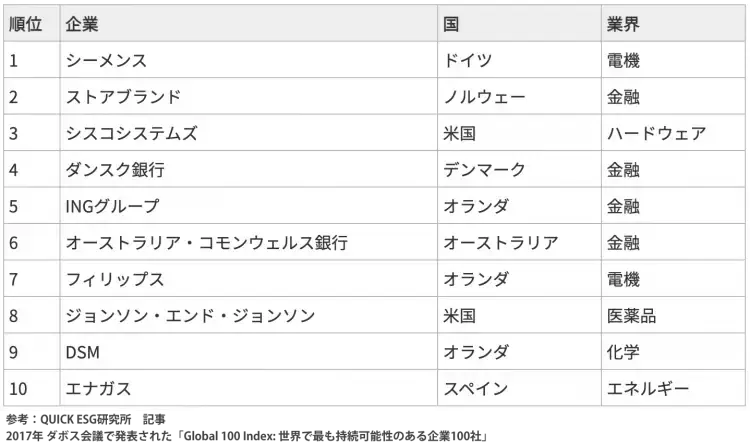
Only four companies from Japan are ranked among the 100: Takeda Pharmaceutical, Sysmex, Astellas Pharma, and NEC. A feature of this ranking is that large companies classified as “elephants” are not necessarily included.
According to David Birch, the true value of “gazelles” lies in their power to lift small companies into highly productive companies in a short period, just as a gazelle leaps. That becomes the momentum of emerging companies.
However, whether an emerging company can survive is a major key. In the United States, it is said that only half of new companies survive five years or more, and only about one-third survive ten years or more.
On the other hand, if they can survive, those companies may prosper and become a threat to existing companies. Facebook and the like are exactly such cases. In other words, as David Birch says, what Japan needs to do now is first to put forward measures that create a large number of emerging companies with the potential to grow into “gazelles.”
If heavy, large-scale existing industries are kept on “life support” indefinitely while maintaining low productivity, it will not lead to the development of national strength.
The OECD surveyed gazelle trends in 10 industrialized countries excluding Japan and reported that 40% of productivity growth came from the replacement of existing companies by new ones, some of which took share from inefficient existing companies.
In comparison, in Japan there is almost no turnover between old and new companies. University students' job hunting also follows the maxim “seek shelter under a big tree.”
Furthermore, becoming a civil servant even seems to be regarded as the best option. With the era of lifetime employment coming to an end, and the employment situation having sunk to the point where becoming a regular employee anywhere is considered good enough, “ambitious” people who think about creating something new have dramatically decreased.
If anything, perhaps due to growing social anxiety over the Great East Japan Earthquake, the declining birthrate and aging population, poverty, and so on, motivated people even seem to be heading in the direction of improving social activities rather than economic activities, for example through NPOs.
To bring about new innovation in Japan, “destruction” is needed to give birth to “creation,” and it is emerging companies that play that role. Rather than low-productivity companies, it is important to nurture emerging companies with growth potential.
This survey immediately shows that the exit rate and new entry rate of Japanese companies are very low. Similar results can be confirmed in other surveys as well.
According to the Ministry of Economy, Trade and Industry's “Total Early-Stage Entrepreneurial Activity (TEA)” index, Japan's rate of new business entry was 4.8%, an increase from the previous year (3.8%), but still among the lowest of 61 countries.
In addition, the likelihood of new companies growing significantly is very low in Japan. According to the “Global Entrepreneurship Monitor (GEM),” the number of employees at companies two years after founding averages 5 in Japan, compared with an average of 10 in the United States. Looking ten years later, the gap becomes much larger: in manufacturing, for example, US companies grow eightfold, whereas Japanese companies only double to 10 employees, and the difference is even more pronounced in the service industry.
“Protecting employment” is important. However, as long as policies like Japan's favor only large companies, “gazelles” will not be born. If things continue as they are, it is clear that the decline of Japan's national strength will accelerate. I believe that for the Japanese economy to regain its vitality and rise again, it is more important to create an environment that gives birth to and nurtures emerging companies.
SMEs Ignored by Both the Government and Partner Companies
Let me explain the business environment for small and medium-sized enterprises in Japan.
The definition of an “SME” varies by industry, but according to the “2016 White Paper on Small and Medium Enterprises in Japan” compiled by the Small and Medium Enterprise Agency, companies classified as “large enterprises” account for only 0.3% (11,000 companies) in Japan. The number of other SMEs (medium-sized enterprises and small businesses combined) is approximately 3,809,000, accounting for 99.7% of all companies. In other words, almost all Japanese companies are SMEs.
Yet when business is discussed, the conversation always centers on large companies, and large companies tend to be seen as the main players in the economy. It is true that SMEs have an image of being “subcontractors for large companies,” but looked at the other way around, large companies' businesses are viable precisely because SME subcontractors exist.
For example, it is said that more than half of the parts used in Apple's iPhone are made in Japan.
Recently, thanks also to online shops, small products can be sold directly to consumers, and it is a fact that SMEs capable of independent management are increasing dramatically. From a different viewpoint, the reality emerges that SMEs are the true main players in Japan. However, the government's measures to revitalize SMEs are weak, and emphasis is placed on measures such as deregulation and corporate tax cuts that ultimately favor large companies.
Even if SME executives want to explore various management strategies, they cannot find the budget, so partner companies that could help with corporate strategy pay no attention to them, and they cannot hire a management consultant on their own.
As a result, executives have no choice but to learn and implement management strategy on their own, by buying books to study independently or attending seminars related to management strategy.
SME executives have neither the awareness nor the time to consider the importance of corporate strategy, nor can they build a support system, so they either constantly gather information on their own or can only have haphazard, short-term outlooks; management methods based on a long-term perspective have not been established.
I was made painfully aware of how the government neglects SMEs four years ago, when I founded my current company. I will omit the details, but I started the company by buying out the business of the company I previously worked for. I steadily saved up funds and poured most of them into buying the business.
However, this was a complete mistake. Right after founding, work came pouring in one after another, but we had no working capital. Needing funds, I rushed to the bank. But the bank was hardly going to agree to lend to a company that had just been founded, had never closed its books, and was too busy even to prepare a trial balance.
When I consulted the person in charge at the bank, I was asked about our sales target. I answered quite modestly, “100 million yen in the first year,” but was laughed at. They did not trust me at all. In the end, the loan was refused. On closer investigation, I found that Japan did not have a system for providing loans to companies immediately after founding. The stance of the government and banks is that public loans and bank loans are available either before founding or after two fiscal periods have closed.
Of course, there are various other ways to raise funds, but as president during the startup phase I was so busy that I had no time to think about fundraising methods.
A growing company is like a rocket launch: it uses the most fuel until it reaches orbit. If fuel cannot be supplied, it simply falls. I juggled funds relentlessly, and fortunately managed to close the first fiscal year without crashing, achieving the sales I had projected.
It then turned out that our tax accountant had dealings with the bank I had consulted earlier, so just in case, they reported the results. The bank seemed surprised. Later, they actually apologized to me.
Since then, I have had a good relationship with this bank. Through this experience, I keenly felt that Japan's SME policies have many problems throughout.