
Breaking down corporate activities into six elements
The components of a company and a bird’s-eye perspective
In Chapter 1, I discussed almost nothing but rather negative topics about how harsh Japan’s business environment is. That is because I wanted you to accurately grasp the current situation companies are in.
“If you know the enemy and know yourself, you need not fear the result of a hundred battles.”
This is a famous saying of Sun Tzu, meaning that if you thoroughly grasp the situation—of both enemy and ally—you will never be defeated no matter how many times you fight.
To put a company’s business environment in order and keep the company going for many years to come, it is impossible to think about the next strategy without first accurately grasping the whole picture. Sun Tzu’s words express this precisely.
So, in the environment described so far, how should companies be managed, and how should they devise breakthroughs in the face of difficulties? Is there no move to turn things around? I have thought seriously about what is needed not only by our client companies but by Japanese companies going forward.
The answer I arrived at was, surprisingly, a simple one.
It is to “create a manual of corporate strategy methods that anyone can use.”
Because corporate strategy is a crucial measure in business, a wide variety of strategy techniques swirl around like a typhoon.
However, just as a typhoon has an eye, I noticed that at its center there was a patch of clear blue sky that no one had noticed. That was “a manual that forms the foundation of corporate strategy.”
The fundamentals of corporate strategy that no one had created
This was around 2008, when I was still an executive at an advertising company.
Producing commercials and other advertising involved many hardships, but it was enjoyable work. That feeling has not changed even today, but at the time, something suddenly crossed my mind.
It was the limits of advertising as a service. We had plenty of requests from client companies, most of them leading firms, so there was no need to worry about such things yet, but a vague doubt and unease kept welling up inside me. Just then, an event occurred that drove my doubts home even more strongly.
Just as the Japanese economy had generally turned upward and employment was increasing, the world was rocked by the “Lehman Shock.” The economies of Europe and the US sank in an instant, and many Japanese companies were dragged down with them.
Our company had supported many companies through advertising production, helping them generate revenue, but seeing companies collapse so easily in the “Lehman Shock,” I was shown vividly how powerless advertising is in a crisis. It made me realize that this might be the limit of the advertising industry in which I had spent more than ten years.
I asked myself, “Should I keep running an advertising production company like this?” and, to find the answer, I decided to study corporate management itself. I judged that earning an MBA at a business school was the right way to study management, and began studying business administration. I also joined several academic societies on corporate strategy and marketing, and made a point of attending many research presentations.
What I learned there was that advertising is only a very small function from the perspective of corporate management as a whole. I am embarrassed to admit that at the time I viewed management only from the field of advertising, my own specialty, and had a truly shortsighted perspective.
My studies at the school brought me discoveries, but as I took various management-related courses, a new question arose. It was: “Are the management methods taught in an MBA documented as a manual?”
An MBA includes various subjects such as “Marketing,” “Finance” and “Organizational Behavior,” but MBA schools do not teach at all “where each subject fits in formulating corporate strategy, and in what order and how they connect.” Even though I was supposed to be studying corporate strategy at business school, things only grew more complex, I lost sight of what corporate strategy is, and my mind became confused. That is when it occurred to me: “If there were a manual for formulating corporate strategy, I could easily organize everything just by studying along with it.”
A familiar example is a driver’s license. Getting a license involves subjects such as classroom lectures and practical training, which are systematized, and the know-how is properly documented in manuals. Similarly, part-time workers at fast-food restaurants and convenience stores have customer service manuals, so the same service is provided anywhere in the country. Home appliances and PCs come with instruction manuals, and there are even textbooks and certifications for operating software.
So I thought that if such a manual existed for corporate strategy, not only I but many executives could organize the complex issues they face and reduce the burden of formulating corporate strategy.
By then I was already on the management side, so I began to think that a compilation of corporate strategy know-how might be usable for employee training. I thought that even without all our staff earning MBAs, they should be able to acquire the know-how to deliver services relatively easily. With this corporate strategy manual, using it for employee training would save time, effort and cost.
The world is overflowing with business books on corporate strategy, employee training and the like. I thought something like what I envisioned might already exist among them, so I decided to look. And even if it differed somewhat from what I imagined, I could modify it to create a new manual and apply it to developing new services.
Thus began my journey, like a role-playing game, in search of a “manual for corporate strategy.” However, the idea born of this naive, simple question would later weigh very heavily on me.
Corporate strategy should be the greatest concern for executives. Since I thought most companies practiced corporate strategy and a great deal of research had already been done, I naively assumed that a systematized manual that could be put into practice quickly and effectively must already exist.
No matter how often I visited bookstores and libraries, I could not find the kind of corporate strategy manual I envisioned. There were books describing steps and know-how for implementing corporate strategy, but from the perspective of the knowledge I had gained through practice and management research, all of them were “neither one thing nor the other” in content. Some were excellent as research papers but insufficient for practice, while others were half-baked or lacking even in theory—far from being useful, they were not even worth referring to.
I also made inquiries with private companies such as consulting firms, associations related to corporate strategy, and even universities. I read hundreds of overseas papers as well. However, I could not find even a scheme showing the flow of strategy formulation, let alone a corporate strategy manual of the kind I had in mind. There was nothing even close to what I imagined.
As a result, I came to the conclusion that no matter how much I searched, no suitable corporate strategy manual that I could call “the one” existed. At the same time, through various research, I gradually began to understand why no one had created a corporate strategy manual.
The stalled integration of management studies and business practice
The first thing I realized was the separation between university management research and business practice. Management research is by nature a field concerned with business practice, so its subjects should reflect the realities of management in Japan and abroad and further invigorate the economy and society.
Of course, there is also basic research in medicine, chemistry, biology and so on, as well as research necessary for pursuing human knowledge and curiosity, such as history and literature, so I do not at all think that “hard to connect to business = useless research.”
However, what I was seeking at the time was practical research in business administration that connects directly to business practice. Yet even in the field of business administration, those doing research were researchers through and through, and few had business experience. In addition, there are strict rules for writing papers. If these rules are not followed, the work is not accepted as a paper. If a paper is not accepted, professors cannot maintain their authority or position, and students cannot obtain degrees or graduate. As a result, this structure of academia places emphasis on passing peer review, and drifts further and further away from integrated thinking, innovative research and practical application. For that reason, everything I found was far from what I was seeking and did not resonate with me.
Furthermore, researchers mainly teach at universities and similar institutions, and especially in Japan the traditional style of “lecturing students” remains central. Recently, practical classes that incorporate various simulated elements in seminars and practicums seem to be increasing, but my impression is that bridging the gap between academia and business still has a long way to go. Overseas universities have shifted somewhat more toward practical application.
Thus, there seemed little hope of a movement in academia to formulate an integrated theory of corporate strategy, and naturally there was no movement at all toward creating a manual applicable to business practice.
Of course, there are things close to the integrated theory of corporate strategy I envision, such as “holistic marketing” and “integrated marketing communications (IMC)” by Philip Kotler, the American management scholar famous for his marketing theory. However, these are limited to the marketing domain and were not sufficient theories to meet my ideal.
Most companies’ corporate strategies are self-taught
Given this background, I decided to use various connections to find out what kind of corporate strategy manuals the many leading companies that truly engage in management and run businesses have. I even swallowed my pride and asked companies I had worked with, consulting firms, major advertising agencies and others in my own industry.
However, no matter how persistently I asked, there was no company that had anything resembling the corporate strategy manual or scheme I envisioned.
To be precise, it is not that there were none. But what existed were manuals related to each company’s services, employee training manuals and the like; there was no comprehensive manual covering what could be called “corporate strategy.”
And yet, companies continue their business activities every day. New products and industry-first services appear one after another. Product upgrades keep advancing. How is it that the economy is moving like this, yet the “fundamentals of corporate strategy” are nowhere to be seen? What do executives and consulting firms—who should be companies’ strategic partners—use to learn about corporate strategy? Puzzled, I went around asking everyone I could, and became even more confused.
To my question, they answered as follows:
“I studied on my own.”
“My boss and seniors taught me.”
“I learned at seminars.”
“I learned in an MBA.”
“A consulting firm taught us.”
And finally, I even received this answer:
“I don’t remember studying anything.”
Among these respondents were people connected with “super” famous companies that you all know. I was stunned. In the end, I could not get a clear answer from anyone.
From corporate executives and senior managers to major consulting firms and major advertising agencies, they were all combining diverse methods and information with their own experience to build their own corporate strategy methods that could not be applied elsewhere.
It is certainly true that “unexpected” events occur frequently—not only in society and the economy, but also geopolitical issues, natural phenomena, accidents and more—creating a highly uncertain social environment. In such an era, relying on templates and manuals carries the risk of hindering the development of corporate culture by failing to generate innovation or to respond to changes in the market environment.
That said, if you jump straight into real combat without learning the basics of management, you are sure to lose. Perhaps I think this way because I spent my youth on karate.
This is common to all sports, but fundamentals are essential to becoming a strong athlete. Karate in particular places great importance on “kata” (forms). Not only in karate but in traditional Japanese martial arts and even the tea ceremony, the ideal process of training is called “Shu-Ha-Ri.”
“Shu” in “Shu-Ha-Ri” means entering as a beginner, seeking instruction from a master, and learning the fundamentals of the discipline, such as its way of thinking and its “kata.” In other words, it is the beginning of training.
After passing through the “Shu” stage, the next step is to interpret those “kata” in your own way, choose what to keep and what to discard, and incorporate your own ideas and novel forms, making them your own. Because this requires breaking the “kata” learned in “Shu,” it is called “Ha” (break).
Once you have firmly acquired your own style and philosophy, you then become a master yourself and walk your own path. This is the final stage of creating and establishing something new, and because you depart from your previous masters and schools, it is called “Ri” (leave).
This “Shu-Ha-Ri” expresses, in three steps, an ideal process not only for training in a “Way” but also in business. As someone who has walked the path of karate, it is already ingrained in my body, and it is a way of thinking that fits me perfectly.
As a result of my search for a corporate strategy manual, it came as a shock to me that there were no guidelines for developing executives or systems for employee training based on this “Shu-Ha-Ri.”
Just the other day, as the “conclusion of my search for a corporate strategy manual,” I had the opportunity to discuss the necessity of a corporate strategy manual with a professor at a certain university.
At that time, the professor asked me the following question:
“Does a corporate strategy manual have any meaning in a rapidly changing market with AI (artificial intelligence) and IoT (Internet of Things: services and businesses provided by devices connecting via the internet without human intervention)?”
In response, I asked the professor:
“Then, when you provide management support to a company, what knowledge do you draw on, and how do you make proposals? Do you leave everything up to the company?”
I pressed further with questions.
“Companies simply want their next move—to solve their issues. For example, there are already situations where rapid market changes and shifts in consumer awareness are causing a company’s products to be replaced by other services. If executives came to you with a sense of crisis, how would you answer?”
After a brief silence, the professor began to describe several methodologies, haltingly. I will not go into the details, but frankly I thought they were commonplace answers, and said:
“Are those measures your own original ideas, or did they come from some standard approach (kata)?”
This exchange may have been like a Zen dialogue.
Certainly, in a rapidly changing market environment, sticking to “kata” may seem odd. But my view is that it is necessary first to master the “kata” of strategy and then create your own methods from there. I tried hard to convey this, but in the end we remained on parallel lines.
What I learned from this exchange was that people like the professor who are involved in many corporate strategies either do not see a need to create a manual—a “kata” of strategy—or think that creating such a manual is utterly impossible.
Even executives of companies whose management has faltered or that have gone bankrupt ran their companies up to that point, so they must have had a certain amount of know-how. Yet they faced a crisis probably because they misjudged something somewhere along the way.
At this point, executives need their next move, but a major obstacle to strategy formulation stands in their way. That is the problem of how to devise a strategy to overcome a crisis in a situation they have never experienced before.
Should they read a vast number of books? Should they go to an MBA or other school to study at this stage? There is no time for that. Most will turn to companies that formulate or support corporate strategy. Then, how should they choose the best support company? A new issue arises.
And if they invest considerable cost to select a support company, some kind of proposal will be made. However, it will probably be an idea different from what they have done so far—because the way they had been doing things failed. Here the executive encounters the next issue: the task of judging whether the proposed new strategy is correct.
“It’s a famous consulting firm, so it will be fine.”
Is it really all right to put it into action on that basis alone? This is how companies invest enormous costs without any basis, and after much confusion, they begin to lose their way.
As far as I know, only a handful of executives have been able to rebuild their companies and build new strategies through this kind of process.
To avoid becoming “lost in management” like this, someone needs to unify integrated theories of strategy and complete the basic form of a manual. I believe that if many executives with high strategic literacy emerge by understanding such a manual and learning corporate strategy systematically, Japanese companies will become much stronger.
However, no one tries to complete such a manual. That is precisely why I resolved that I had to do it.
Academia emphasizes scholarly analysis and delves into prior research, so it can look into the depths, but integration with business practice cannot be expected.
Executives, on the other hand, have no motivation to develop an integrated manual, because they only need to formulate strategies for their own industry—or, more precisely, their own company. In fact, if they developed their own strategy manual, they would not want competitors to know about it.
As for the method of passing management on to successors, they think it is enough to promote someone who can carry on the company’s traditions or someone promising. If there is no such person in the company, they think it is no problem to recruit one from another company.
But as a matter of fact, with that approach, the performance of companies, especially SMEs, has declined sharply, leading to the worst outcomes such as bankruptcy. That is why I wanted to complete a corporate strategy manual and scheme that maintains a certain standard, and save as many companies as possible.
In corporate management, the latest theories and technologies are born every day amid a storm as violent as a typhoon. However, the eye at the center of that typhoon—that is, the foundation—was empty, completely missing.
This is the “blue sky at the center of the typhoon” that I found. And so I realized that developing a manual for corporate strategy is absolutely essential for Japanese companies to achieve new vitality.
That said, while it is easy to say “develop a corporate strategy manual” in a word, actually creating one is another matter. It involved truly great hardship.
The first thing I did was to once again comb through anything resembling a corporate strategy manual that I had already searched for. I thought that if I found the thing closest to the corporate strategy manual I had in mind, I would only need to improve it. I resumed my investigation into whether such a manual existed, went around asking people, and reread every document and paper. After spending a full two years on this work, I concluded that, even as a basis for improvement, there was nothing that could serve as a reference for a corporate strategy manual. This forced me to decide that I had to develop a corporate strategy manual on my own.
However, having gained so much knowledge, when I imagined the difficulty of developing the corporate strategy manual that was about to begin, I was utterly dumbfounded. Above all, I was overwhelmed by the sheer volume and complexity of information. No wonder no one had attempted to systematize a corporate strategy scheme.
Then I suddenly remembered a group assignment I had done at business school.
At business school, we were given practical assignments involving member participation. One of them was formulating the corporate strategy of a major home appliance manufacturer. As the group leader, I realized that the existing frameworks (*) we had learned at business school could not lead to solving the management issues. So I decided to create a new one, began developing a framework with my team, used our original framework to formulate the home appliance manufacturer’s strategy, and gave a presentation.
*A framework is an analytical tool or thinking structure useful for corporate strategy, business improvement, problem solving and the like. Often taught in MBA programs, frameworks systematically organize the logical thinking and ideation methods needed in business. Examples include SWOT analysis and Five Forces analysis.
The professor at the time had previously worked for a major foreign consulting firm. Our presentation seemed to go well, but for some reason creating a new framework angered him, and our group’s grade was lowered.
However, my teammates showed their understanding, saying, “Someday this framework will see the light of day.”
Later, when I met the professor again, I heard that I was about the only one who had ever created a framework in his class, and that he had been so taken aback by something so unconventional that he had ended up lowering our grade.
Be that as it may, I dug out the framework I had created back then, and when I looked it over again, I intuitively felt, “Maybe this could work.”
Though rough, the framework I had thought through so seriously back then gave off the sense that it could become the basis for the corporate strategy manual I was seeking. Remembering my MBA group members’ words, “someday it will see the light of day,” I decided to try improving this framework.
Formulating corporate strategy by breaking down corporate activities into the “six fundamentals”
Corporate strategy involves a mountain of subjects such as “Finance,” “Organizational Behavior” and “HRM (Human Resource Management: a personnel management method for comprehensively managing employees).” First, I organized and classified strategic methods, terminology and so on by theme.
Next, I delved into the meanings of the terms. What is the difference between promotion and marketing? What are the actual methods of branding? What is the difference between corporate strategy and business strategy? In what order should corporate strategy be implemented? Based on this analysis, I organized the sequence of strategy formulation and created a rough “map.”
I then fitted detailed strategic methods into this corporate strategy “map,” and the prototype of a practical corporate strategy manual was complete. However, this alone was not yet enough to formulate corporate strategy. To apply it in practice, the manual needed to be packed with the latest strategic technologies of all kinds. Only by also shaping it into something anyone can understand and use is a corporate strategy manual finally complete.
Let me explain the corporate strategy manual that was completed through this process.
As mentioned at the beginning, “strategy” is a military term. It may be inappropriate in times like these, but in war, the following process is followed. The first thing done is research and analysis. You need to investigate the enemy’s troop strength and number of weapons, and understand your own country’s troop strength, number of weapons and their power.
Furthermore, you must set a goal of defeating the enemy and share that goal not only with soldiers but with the entire nation.
Next, you consider what kind of armaments and army to build. For example, if research reveals the enemy’s weakness, you build armaments to strike it effectively and devise a plan for how to attack. This is the operation plan.
Once the operation plan is decided, you prepare the weapons and personnel to match it, and decide the timing and actions for fighting in a way that gives you the advantage.
Having made these preparations, you enter actual combat. You deploy forces according to the plan and fight. When the battle has settled, whether you won or lost, you need to analyze the results. Based on those results, the next direction is decided: further research, a change of plan, a change of armaments, or even raising the white flag. This is the flow of a war.
The corporate strategy manual I came up with resembles the conduct of war, and in a sense I was able to reduce it to a very simple pattern.
Now, let me introduce the actual procedure (scheme) for formulating corporate strategy.
First, break down a company’s activity elements into the following six. The scheme is complete simply by plotting these elements on a circle.
In fact, corporate strategy planning can be formulated with just these six elements.
“1. Research & Analysis”
“2. Corporate Strategy”
“3. Business Strategy”
“4. Marketing”
“5. Management”
“6. Operations”
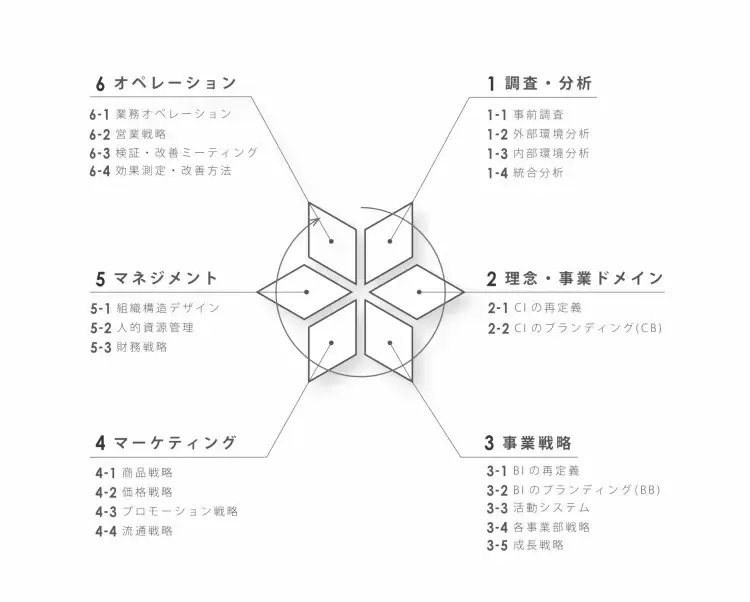
Because this corporate strategy scheme consists of six elements as described above, I named it “6e.” “6e” may look like a simple structure, but it lets you review every item needed for corporate strategy from a bird’s-eye view.
Where is the goal we envision, and what should be placed where to achieve it? That differs for each company and each executive’s thinking. But what should be done at what timing ought to be common to all companies. Rather than picturing it vaguely in your head, visualizing it with this diagram makes “what to do when” clear.
Even more important is that it allows you to accurately convey the strategy you envision to other people—that is, senior managers and employees. This enables executives and employees to share the same goal and process, and move forward as one.
This scheme based on “6e” is still continually being revised to remain a cutting-edge corporate strategy scheme by incorporating feedback from practice, the development of new strategic technologies of all kinds, and the latest papers published in the field of management studies, deepening our research.
Because our company is also built on my experience in advertising production, when we actually bring “6e” to support a client, our strength is that we can propose everything in one package—from formulating corporate strategy to deploying “weapons” (tools such as video, web, events and graphics) and even IT to improve the business environment. Perhaps its greatest feature is that “6e” is positioned as the guideline for this. This corporate strategy scheme has been adopted by more than 1,000 companies so far. Those successes are further verified and analyzed and accumulated as new know-how, forming a large database. “6e” evolves day by day like a living thing.
Now, from the next chapter I will begin explaining each part of corporate strategy, so let us try formulating your own company’s corporate strategy along the way.
However, I must first explain the following points of caution.
The six fundamentals of corporate strategy I am about to explain are strictly an introduction to the basics of corporate strategy. Introducing all the essence of corporate strategy would be impossible within the page count of this book. (Even this amount got me scolded by the publisher.) So what this book can introduce is limited to the components of corporate strategy and a few case studies.
Therefore, for the various corporate strategy know-how that cannot be covered here, please look for books on topics related to each part. I believe that if you formulate your business plan that way, it will become considerably more accurate.
Also, if you are not in a senior management position, try formulating your own company’s corporate strategy by following the items. You may unexpectedly be able to formulate a new corporate strategy, or make new discoveries. It is true that when our company formulates corporate strategy for clients, complex circumstances are indeed intertwined in the actual field, and it is not uncommon for business plans to run to about 300 pages.
Even so, I believe there is value in reconfirming the basics of each part with this book.