Clarify your company’s mission
How important is a corporate philosophy?
The next elements necessary for reliably executing corporate strategy are establishing a philosophy and defining the business domain. First, let me briefly explain the terms.
A “corporate philosophy” is the fundamental way of thinking behind running a company. It is the pillar that a company must value most.
A “corporate domain,” on the other hand, is in a word defining “we are a ___ business.” There are quite a few companies that spread themselves across multiple areas—wanting to do this and that—did well for a while, but ended up failing at all of them. It is better to firmly secure a position—“this particular spot in this industry”—which makes it easier to focus and develop corporate strategy. Especially for SMEs, if this part is not firmly established, the company will fall apart in no time.
First, let me introduce some cases showing why corporate philosophy and corporate domain are important.
The fate of management without a philosophy
There is a company that deals in outdoor toys such as Frisbees, boomerangs and skateboards. Our relationship began when we received a request for web production several years ago. The president’s request was only to renew the website. If that were all, it would just be a cosmetic touch-up, so to be honest it could have been done easily. However, when we receive requests to produce various tools (video, web, etc.), we start production only after grasping, based on “6e,” what the company is aiming for and what environment it is currently in.
In this case, since it started with a web production request, we first checked the current website. However, while it had product descriptions and told us a lot about the products handled, we could not tell what the company itself wanted to do or what it wanted to communicate to customers.
So we first interviewed the president and analyzed the company’s business environment.
What we found was that the toy manufacturer market faced a declining number of children—its target—and a social climate in which the negative effects of video games and the like on children were seen as a problem. We strongly sensed the president’s will: he had no intention of handling toys like video games, and wanted to be a trading company focused on outdoor toys that use the body and foster children’s healthy growth. Even within toys, major toy manufacturers still hold great power, and competing head-on would certainly mean defeat.
Therefore, before producing the website, we decided to create a corporate philosophy and redefine the business domain. The corporate philosophy created was: “Through the planning, sale, import and export of sports toys, we contribute to the education of children around the world.” This simply drew out the president’s love for sports toys. Yet the corporate philosophy contained various essences.
The first effect was on the purchasing staff of its customers—toy stores (in this case called distribution)—and on employees. The distribution channel, its main customer, came to recognize the value of sports toys. What had been mere toys were re-valued as products that support children’s healthy growth. Likewise, employees were able to reconfirm their company’s contribution to society.
Needless to say, this energized employees’ engagement with their work. In addition, although skateboards, Frisbees and other sports toys had existed for a long time, the genre of “sports toys” came to be newly recognized. As a result, not only was the company differentiated from major toy manufacturers, but outdoor specialty shops began selling its products in stores as toys for outdoor use, and the company tripled its sales in one year.
Let me introduce one more case.
When talking about corporate philosophy, there is one story I simply cannot forget.
It was a documentary following a young man working at a company that cleans apartments and condominiums. Moreover, it was not an ordinary cleaning company, but one specializing in “stigmatized properties”—where suicides or the solitary deaths of elderly people had occurred.
The story began when a young man joined the cleaning company specializing in stigmatized properties as a part-timer. His dream of becoming a musician had been crushed, and he started working at the cleaning company just to earn a living. His work was lackluster, he made mistake after mistake, and he showed no motivation. While thinking this young man would surely quit, I could not take my eyes off the screen.
Then one day, the president takes the young man out for drinks.
The president had originally run an ordinary cleaning company, but it fell into financial difficulty, and he happened to take on the cleaning of a stigmatized property. When the cleaning was finished, he received words of gratitude from the bereaved family, and in that moment he realized, “If I don’t do this work, who will?” Since then, his company has specialized in stigmatized properties.
However, while viewers of the program knew this from the narration, the president told the young man almost none of this story over drinks.
Yet the young man, who seemed to be working only reluctantly, had in fact been watching the president’s example and sensing the meaning of this work.
The story jumps ahead several months. There was the young man, working energetically. He had not quit. Despite myself, I could not stop crying.
I was moved that even a cleaning company specializing in stigmatized properties—work that people would rather not do—had a fine “unspoken philosophy,” and that the young man was where he was today because he had been inspired by that corporate philosophy.
Watching this also made me realize that my own approach to formulating philosophies still had shortcomings.
However small the aspiration, however small the company, if there is a reason for being and a firm philosophy, people will grow. That was an experience that became engraved in my heart.
As these two cases show, you will understand that a management philosophy is a very important element of management, yet in actual management practice, formulating the philosophy tends to be left behind.
If either is lacking—such as executives not understanding the management philosophy, or the corporate domain being unclear—the company will be at risk in the medium to long term. Only when both are properly in place does the future outlook open up.
Executives, have you designed a philosophy that considers the meaning of your business and your employees’ sense of fulfillment? Earning a salary is important for employees, but they are entrusting most of their lives to the company and to you, the executive. That is exactly why you have a responsibility to find your business’s contribution to society and its organizational meaning, and to put it into a philosophy. You need to fulfill that responsibility.
Many executives make management their purpose in life and are absorbed in it. However, some executives become so absorbed in management that they leave their employees’ feelings behind. They forget that, unlike the president, employees devote most of their lives to the company for a fixed salary.
Certainly, being a president is a high-risk, high-return world, and management has a game-like aspect. Most presidents even enjoy that situation. That is fine for a one-person startup, but how do you think employees, who are staking their lives and their families’ livelihoods, view such a president?
The answer is simple. They are surely thinking, “I can’t keep up with this anymore.”
For employees, work content and income are important, but what they value especially is a “sense of fulfillment.” More specifically, they think about the meaning and role of their own lives and whether these can be realized at this company.
What happens to a company when what the executive seeks and what employees seek diverge?
In my experience, when sales come first, the company invariably falls into a profit-first tendency that leaves behind not only employees but even customers.
Employees are on the front line of customer service, so they cannot accept serving customers solely for the sake of the executive while they themselves are being left behind. They begin to think only of leaving the company in search of a new mission and sense of fulfillment.
A company with many people leaving cannot even attract new graduates or mid-career hires. In recent years, “black company lists” have even been posted on online message boards and Twitter. No one would dare to jump into such a company.
When executives begin to find their work interesting, they instead forget to look around and just keep charging forward. That is where they tend to lose sight of what is important: people, the organization and customers. Once it gets to that point, everyone leaves, saying “go ahead and do it alone,” and the game you were enjoying is over.
This is not saying “spoil your employees.” It means having a philosophy that everyone can accept and find fulfilling, and sharing it among everyone. I believe that is the moment to exercise leadership as an executive.
Think of corporate philosophy in “layers”
Now, I will introduce the essential items of a management philosophy, so please check what your company is lacking.
There are various ways of thinking about corporate philosophy, and experts define it differently. In general, however, it can be explained as a four-layer pyramid as follows.
- Corporate philosophy (top)
- Code of conduct
- Mission
- Vision
A management philosophy is the formulation of the basic way of thinking that a company’s founder and executives hold about managing the company. It may be expressed as a belief about the company’s social role, or as a way of thinking about the company’s internal administration and operation. With this management philosophy at the top, what is required next is a code of conduct. Based on the corporate philosophy, guidelines are needed for how everyone—not only executives but also senior managers and employees—should act.
Below that is the mission. Every action leaves a result behind. That result is the mission the company has accomplished, and if it is not appropriate, then the mission that was set was wrong. It is important to define the mission properly from the outset so that this point does not waver. A mission generally declares a contribution to society and, as the word implies, connects to the company's social role.
Finally comes the vision. A vision is an image of the company's future once it has achieved its mission, or of the future of the society it has contributed to. The vision is determined by what the executive desires. Perhaps it is “No. 1 in customer satisfaction.”
It could also be corporate growth accompanied by achievements such as an “IPO” or large sales. There are also examples where it is hard to separate mission from vision, such as “Making society better through robotics technology.” For now, it is enough to think of the mission as defining the company's role and the vision as expressing the future the company has created.
In this way, it is generally good for a company to define everything from its philosophy to its vision, but there are no firm rules for this; it is formulated using the company's own methods or the methods of the consultant who develops the philosophy.
A corporate philosophy also affects a company's business performance.
Several studies have shown that company growth and size, together with the presence of a philosophy, push up business performance. Like “the chicken and the egg,” it is impossible to tell which comes first between philosophy and corporate growth, and causality has not been established, but it seems clear that performance rises precisely when a corporate philosophy and growth coexist.
However, please note that there are two bottlenecks when introducing a corporate philosophy.
The first is the executive's lack of understanding of the philosophy. An executive's job is to run the company. If management goes well, their social standing rises and they can earn a corresponding reward. Conversely, if they fail, they may literally be left out on the street, with a miserable life awaiting them. Executives are people placed in this two-sided relationship.
For this reason, most executives tend to become absorbed in management itself, and many place management at the very foundation of their lives.
Of course, there is nothing wrong at all with being absorbed in management. However, while this may be fine for a sole proprietor, if you have employees and simply brandish your own personal “burning passion” as you please, it may just spin its wheels. You may even be labeled a “one-man executive” and find that no one will follow you. At that point, the company's mission can no longer be achieved. Executives are required to understand that the management philosophy does not belong to them alone, and to have the leadership to unite everyone as one without merely wielding their own feelings.
The second is the problem of the consultants who formulate the philosophy.
As stated in Chapter 1, if the consultant, who should by rights be supporting management, lacks ability, then no matter how hard you try to formulate a management philosophy, only something off the mark will emerge and it will be of no use at all. When an executive engages a consultant, it is important to have the understanding and literacy to judge properly whether the advice is accurate. If you leave your management strategy entirely to a useless consultant, you will lose your future.
The late Steve Jobs, founder of Apple, said this:
————————————–
We're betting on our vision.
(omitted)
What's always important to us is the next dream.
————————————–
————————————–
Please believe that what you are doing now will connect somewhere.
Because believing that the dots will connect somewhere gives you the confidence to walk all the way, even if you are walking a different path from others.
————————————–
These words tell us something very important about philosophy. A philosophy is a strong conviction that persuades people and makes them want to walk with you. Passion that is never self-righteous is exactly what a management philosophy is. That is what I believe.
Redefining CI and Branding
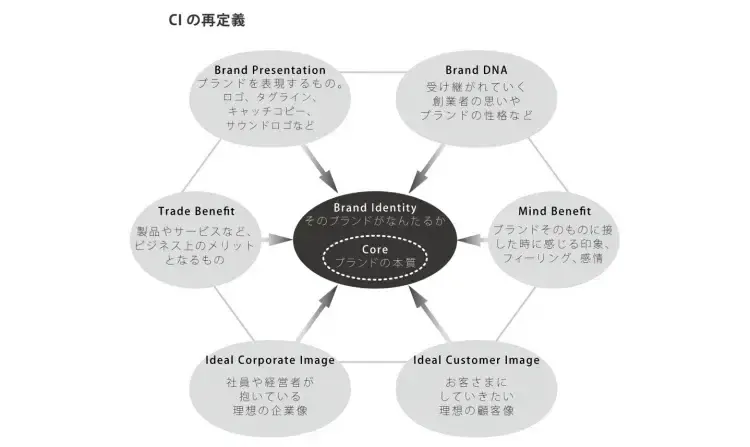
Now, once you have designed or reviewed your philosophy and corporate domain, the next step is to redefine your corporate identity (CI) and carry out branding.
Having gone to the trouble of creating a philosophy and corporate domain, this is the activity of expressing it to stakeholders such as customers and employees. It is the same as falling for someone: if you do not convey your feelings by email or letter, the love will end up unrequited.
(1) Redefining Corporate Identity (CI)
Redefining corporate identity is the process of giving form to those convictions through the review of the philosophy and corporate domain described above.
Specifically, think of it as creating a corporate logo, corporate slogan and so on that express the philosophy and corporate domain.
(2) Branding of Corporate Identity (CI)
Next, carry out branding (*) activities to communicate the corporate identity.
The convictions established by redefining the corporate brand are meaningless unless they are communicated to those around you. Branding activities are needed for that.
For a company, it is important to link not only its products and services but every element surrounding it, including employees and advertising, with customers at a single point, and to send out a consistent message.
Embedding the corporate brand not only externally but also internally generates great momentum. Through branding activities, you can have people understand the company's direction and reason for being, as well as the value of its products and services. That is “branding.”
* What is branding?
Activities to build a brand that is valuable to customers and consumers. The aim is to raise customer and consumer interest and promote purchasing by clearly presenting the brand's characteristics and its differences from competing companies and products. Deepening the relationship of trust with consumers improves the brand's appeal and allows it to gain an advantage over competitors.