
Business Strategy Determines a Company's Rise and Fall
There Are Many Types of Business Strategy
Next, at last, comes formulating the business strategy.
A company may focus on a single business or operate several types of business. Corporate strategy is the single thick vector a company holds. Business strategy, by contrast, is needed for each business the company runs, because it is a strategy defined for each individual business. This is the major difference between corporate strategy and business strategy. It is remarkable how many executives and consultants confuse the two. Not infrequently, communication goes awry because of differing understandings on each side, leading to trouble.
The quality of this business strategy greatly affects the rise and fall of the entire company. Personally, I very much enjoy designing business strategy, and when a good strategic design comes together, I feel as if a beautiful form, though invisible, is emerging; and in fact it dramatically turns around a company's performance.
Business strategy must, of course, be formulated for each business. You may devise a business strategy suited to your company by referring to strategies other companies have implemented, or you may update the strategies your company has pursued so far. However, because the business strategy is itself an important element that leads directly to the next step, failures that force you to backtrack are not acceptable.
Among the types of business strategy, there are many methods besides the “activity system” introduced below, such as management methods for comprehensively managing business units, growth strategy methods, game-change methods that overturn a market monopolized by major players in one stroke, and new business development. Due to space limitations, however, only one business strategy method is introduced here. Many published books are written about business strategy, so why not look for books covering the business strategies you think your company needs?
The “Activity System” That Lets Even SMEs Beat Major Companies
Here, I would like to introduce only the “activity system” as one business strategy method.
The reason I want to introduce it is that I personally like this business strategy.
As a business strategist, I find it very rewarding when I complete this design.
It is also extremely important and becomes the source of a company's competitive advantage.
Even a weaker company can compete with major companies by building this “activity system.”
As an example of this “activity system,” I would like to introduce the difference between the “activity systems” of the famous hamburger chains “McDonald's” and “MOS Burger.” Since nearly everyone has probably eaten both companies' hamburgers, there is no need to introduce them.
First, “McDonald's” “activity system.” As you know, “McDonald's” opens its stores on prime sites in front of train stations. This is because there is heavy foot traffic, allowing them to attract large numbers of customers. These passers-by range from children to adults. Also, because there are so many customers, neither service nor cooking can take much time, and because rents are high, costs such as ingredients must be kept low. As a result, the ingredients, seasoning and processing of the product, the hamburger, become standardized and simple. In addition, to shorten service time and streamline cooking, they focused on creating manuals and pursued efficiency. In this way, “McDonald's” rapidly expanded its sales.
Hamburger chains that followed this “McDonald's” business model competed with similar systems, and all of them struggled.
So “MOS Burger” built a new “activity system.”
First, what it emphasized was the training of store managers and employees. “MOS Burger” believed that these store managers and employees would bring in customers, so it focused on recruiting and training people. Also, at the outset, it chose rental properties with less foot traffic rather than in front of stations. Would customers come? Unlike “McDonald's,” which regards people passing in front of stations as its customers, “MOS Burger” believed that by offering excellent store staff and a comfortable atmosphere, customers from the entire local area would come. Moreover, with low rent, it could spend time on ingredients and cooking and serve very delicious hamburgers. In this way, “MOS Burger” fans and repeat customers increased, and even if the location is somewhat poor and the wait for cooking long, customers wait without stress.
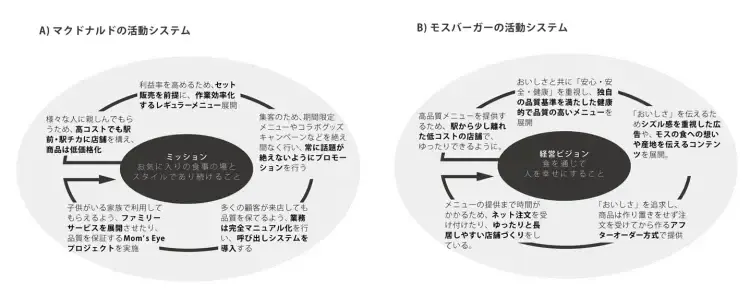
Now, can you see the difference between the two companies' business models?
In this way, in both “activity systems,” the individual activity elements are neatly coordinated and linked like a chain, creating a robust business model. It becomes difficult for “McDonald's” and other hamburger chains to imitate “MOS Burger,” and conversely, difficult for “MOS Burger” to imitate “McDonald's.”
Once such an “activity system” is in place, it becomes difficult for other companies to enter, and you can fully compete even with major companies.
Overseas Examples of Functioning Activity Systems
Let me also introduce an overseas example.
The company that built a superb “activity system” is an airline called Southwest Airlines. It is a pioneer of so-called low-cost carriers (LCCs). In the United States, where most airlines have seen sluggish results or gone bankrupt, it is a rare airline that consistently posts stable results.
Moreover, despite its low pay levels, the company has low turnover and is highly popular as an employer. Why is that?
The reason is precisely that its “activity system” is running at full capacity.
Airlines usually use an operating method called “hub-and-spoke,” in which aircraft and crew travel around various airports. For example, an aircraft arriving from Los Angeles goes next to New York, and then on to Miami. It is a system in which aircraft and people move from place to place.
Southwest Airlines, however, has introduced an operating method called “point-to-point.” Its base airport is Dallas Love Field. Then, with focus airports such as Las Vegas and Chicago, the origin and destination are fixed, and planes fly out and turn back.
Also, an airline with various aircraft types must prepare maintenance equipment, mechanics and parts for each type, but because Southwest Airlines uses the same aircraft type, its maintenance costs fall dramatically.
With the “hub-and-spoke” method of traveling around various airports, crew and flight preparation take time and aircraft turnover is low, whereas with “point-to-point,” planes simply shuttle between two airports, reducing preparation work and raising turnover. Because the base is fixed at Dallas, crew members simply go out and come back as if commuting normally. There is little need to move from place to place without returning home the same day. Since there are basically no transfers either, they can settle down and have a home. In an age when “customer first” is common, prioritizing employee satisfaction over customer satisfaction resulted in the birth of a casual airline that employees do not leave.
In this way, the role of connecting other points around one central point becomes a chain, and both the company and its employees can engage in the business with peace of mind. It seems that crises came again and again until they found this method, but they overcame them, and that is how today's Southwest Airlines came to be.
This too is an excellent model of an activity system. A business linked by a strong “chain” can defend itself against competitors trying to follow it.
Redefining BI and Branding
Now, once you have reviewed your business strategy, the next step is to redefine your business identity (BI) and carry out branding. Having gone to the trouble of creating a business strategy, this is the activity of expressing it to stakeholders such as customers and employees.
(1) Redefining Business Identity (BI)
As with corporate identity, this is the process of giving form to those convictions through the review of the business strategy described above. Specifically, think of it as creating a business logo, business slogan and so on that express the business. Business identity (BI) means determining and presenting what the business is like, its individuality. If this part is missing or wavering, the direction of the business strategy cannot be communicated. So you review the business concept, message, target and so on, “who the business is for,” and rework “how it will be delivered.” It is the work of clearly stating and deciding the brand's characteristics and individuality.
(2) Business Identity (BI) Branding
Once the business identity (BI) is decided, the next step is the work of branding it. That is business identity branding. If this is established, even in the face of competition you can sell many products without being drawn into price competition and cutting prices. This is because, through the brand name, logo and so on, customers are made to share certain values and images. Business identity branding is an important method for increasing corporate profit and stabilizing management over the long term.