
Leveraging the Characteristics of Products and Services
What Are the “Selling Measures” That Lead to Business Results?
Once the general direction of the business has been set through the business strategy, the next step is to design the activities that actually lead to company sales. That is formulating the marketing strategy.
Marketing refers to the planning, development and design of products and services themselves, pricing strategy, promotion and branding of products and services, distribution measures and so on. These are commonly called the 4Ps of marketing (price, product, promotion, place). Optimizing these marketing activities is called the marketing mix, and when this optimization goes well, the sales effect of products and services can be maximized.
Companies That Spend on Promotion Are Not Necessarily Good at Marketing
I would like to introduce the example of major semiconductor manufacturer “Intel.”
“Intel” mainly produces CPUs, the heart of personal computers.
So its main customers are, naturally, PC manufacturers. In 1991, Intel launched the branding promotion “Intel Inside.” You have probably heard this phrase in commercials. Now, why did “Intel” carry out this branding promotion? CPUs are installed inside PCs, and those who actually buy the CPUs are the PC manufacturers. Yes, the transactions are B2B, between companies. Nevertheless, Intel deliberately advertised to PC users. Its aim was as follows.
First, it asks PC users, “Is Intel inside” your PC? PC users then check whether their PC has an Intel CPU, and think that PCs with Intel CPUs might be superior. PC users then gradually come to buy PCs with Intel CPUs. As a result, PC manufacturers have no choice but to choose Intel from among the many CPU makers. This is how Intel grew rapidly.
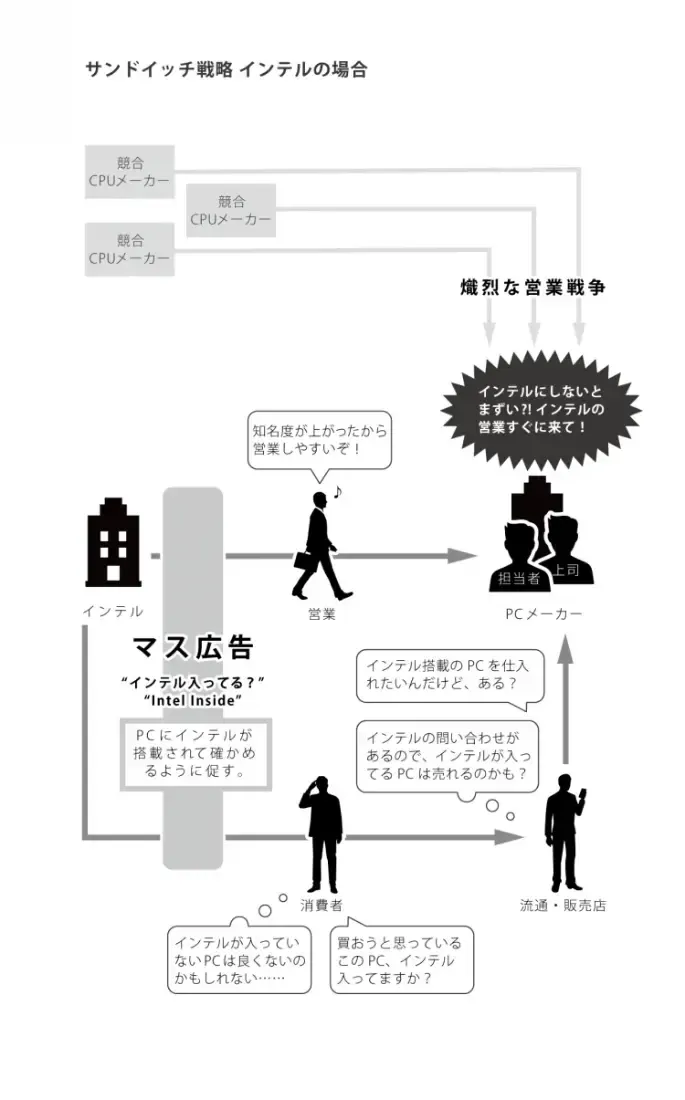
I call this the sandwich strategy (simple as it is). In this way, marketing aims to coordinate product, promotion, distribution and so on to achieve the maximum sales effect.
(1) Product and Service Strategy
Explaining product and service strategy alone would fill several books. Product and service strategy is also very important; it is no exaggeration to say that it is the strategy most closely tied to a company's rise and fall.
And, needless to say, this is the part executives regard as most important.
However, there are countless cases where a company first sells some product or service, sells reasonably well, but it does not last; it then scrambles to develop or procure a new product, but that product or service does not sell, and the company goes bankrupt.
Moreover, developing or procuring a product or service that won't sell and then drawing up the promotion strategy described in the next section is suicidal. Why?
For example, suppose an entrepreneur decided, as a new business, to open a restaurant right in the city center.
When it opened, many customers came, but gradually they stopped coming. And since it was in the city center, the high rent weighed heavily, and it was forced to close.
So why was it forced to close?
It was simply the taste of the ramen. If it isn't delicious, customers won't come back. Worse still, because so many customers had come, negative branding as “a bad ramen shop” spread, accelerating the countdown to closure.
It sounds like a joke, but this kind of thing actually happens frequently.
Having seen many executives, what strikes me is that they treat their own products and services as absolute, and overconfidence arises.
That is natural, since they spent money and effort developing them. And the employees around them, sensing the president's feelings, are in an atmosphere where they cannot speak up honestly.
Conversely, an old ramen shop on a quiet street may well have reliably good taste.
Because it is delicious, once you eat there you want to eat there again, and customers gather through word of mouth.
I also had a period as a TV director and saw many such renowned shops, and when I requested to cover them, there was a line the owners would invariably say.
“I don't need TV publicity. I'm not short of sales, and it'd be a nuisance for my regulars.”
I have seen many executives who feel that if you make good products and services you don't need promotion, and in actually dealing with many companies, I have witnessed that the companies making good products and services are the ones that do not carry out promotional activities. From this experience, I came to think that, conversely, companies that are aggressive about promotion may not be offering good products and services. In fact, I was formerly involved in running an advertising production company, and it was through such experiences that I also felt the powerlessness of advertising. Now, however, I do feel that promotion is necessary after all. I will explain this in the next section.
Since product and service strategy is this important, it is essential for executives to analyze the environment surrounding their products and services, gather the voices of many consumers, and formulate the strategy.
In product and service strategy, of the “core function,” “form” and “ancillary functions” that make up a product item, the point marketers actually struggle with is the “form.” A product's form has five characteristics: “features,” “style,” “brand name (naming),” “packaging” and “quality.”
What is particularly important in devising a strategy is knowing the characteristics of the product. What features does the target product have, how many varieties are there, what price ranges exist, and who buys it? Investigating these thoroughly leads to quite different ways of building a product strategy.
Many books are available on product and service strategy, and I recommend referring to them. Mastering these techniques, informed by your own company's experience, enables lasting sales of products and services.
(2) Redefining Product Identity (PI)
As with corporate identity, this is the process of giving form to the characteristics of a product or service through its development, procurement and review. Specifically, it involves developing product or service names, catchphrases, product or service logos and so on that express the product or service. Product identity (PI) means determining and presenting what the product or service is like, its individuality. If this part is missing or wavering, the direction of the product and service strategy cannot be communicated. So you review the concept, message, target and so on of the product or service, “who the business is for,” and rework “how it will be delivered.” It is the work of clearly stating and deciding the brand's characteristics and individuality.
(3) Product Identity (BI) Branding
Once the product identity is decided, the next step is the work of branding it. That is product branding. Now, I want to say something important here about branding. I imagine there is no one involved in management who does not know about branding. However, even in my years in this industry, only a handful of people have clearly been able to explain the essence of branding and how to do it. Some answer that branding = advertising strategy. That is not wrong, but it is not an accurate answer. First, let me explain why branding is necessary. An example I often give is beverages.
For example, suppose you played sports in midsummer and are standing in front of a vending machine. What comes to mind? Some will say Coca-Cola, others Pocari Sweat. This is called brand association, and the higher this association rate, the more sales grow in proportion. That is why, to raise awareness, the interpretation that advertising = branding arises.
However, the essence of branding does not lie here. For example, suppose there is a popular set-meal restaurant nearby. Naturally, that restaurant does no advertising. A customer who happened to drop in found the katsudon delicious and became a repeat customer. They tell someone that this restaurant is good, and this word of mouth brings in even more customers. Yes, the essence of branding is, after all, making good products and services, and further, letting customers experience them. In doing so, you convey the product's identity (individuality) and have customers form a good impression. Our company's branding strategy focuses first on facts (building facts). In short, from creating the product or service, we emphasize the experience of that product or service. Then, helped by word of mouth and the like, the product or service gradually takes root deep in customers' minds. As a result, advertising becomes inversely less necessary, and we regard advertising strictly as a complement to branding. Furthermore, the “-ing” of the present progressive in “branding” signifies continuing these activities over the medium to long term.
Let me describe the example of one of our clients, the Swiss luxury watchmaker “Breitling.”
This watchmaker is distinctive for its aviation watches used by pilots, priced at over 1 million yen. Moreover, these watches have become winners even in the sluggish watch industry, and sales remain strong today.
So how do they brand these watches?
Remarkably, they host and produce many aviation events every year. They also actively sponsor outstanding pilots, constantly maintaining their position as an aviation watch and raising awareness.
They do run TV commercials occasionally, but what they value most is creating many opportunities for customers and prospective customers to touch the watches, at these air shows, in stores and so on.
This manufacturer understands the principle of “more haste, less speed” well and maintains its current position by never cutting corners.
Conversely, watchmakers that neglect branding and devote themselves only to selling are seeing sales decline steadily.
I think you can now see that branding is not = advertising.
First of all, developing high-quality products and services is the essence of branding, and what matters is how you have people experience those products and services continuously.
Once a brand has been established, a product or service brings many benefits.
The price difference depends on the item, but it is said to be 10 times or even 100 times.
Yes, when a woman buys a bag, for example, the reason she pays a large sum for a brand bag over a non-brand one is precisely brand power.
(4) Pricing Strategy
Pricing strategy means drawing up a profit plan for products and services and setting prices based on it. There are broadly three types: “high-price strategy,” “mid-price strategy” and “low-price strategy.” You may well remember the “low-price wars” of discounting fought over hamburgers and gyudon, which did not produce much effect. Conversely, adopting a “high-price” strategy to create a sense of premium is also one method. Various ideas readily arise in selling products, such as “special price for a limited time” discounts, but they also carry the risk of generating losses unless approached flexibly, so care is required. It is a very important element in planning a marketing strategy. Pricing strategy is also deep, with various methods, but here too I will introduce just one example.
Our company provides strategic support not only to companies. We sometimes support athletes and entertainers as well. Connected with the aviation theme of the previous section, one person I would like to introduce is Yoshihide Muroya, an air race pilot. The air race is “Red Bull Air Race,” an airplane race organized by a major beverage company.
Many of you have probably seen it on TV at least once.
I met him more than ten years ago at an aviation-related event, and at that time he asked me, “Mr. Ashida, I want to start an air show team. Would you support me?”
Since I also love airplanes (I hold a pilot's license), I gladly accepted.
However, even though he wanted to start an air show team, he had no track record, so I wondered how to give shape to his aspirations. Even if we launched an air show, there were virtually no pilots anywhere in the world making a living solely as air show pilots.
Even so, despite his lack of a track record, we first searched for sponsors to support him and for local governments that would pay for his air shows, but we were turned down every time because he had no track record.
So we changed strategy and approached it differently: “Why not fly once for free?”
The place that let him fly was a race venue.
That single track record paid off; requests for air shows poured in one after another, eventually he was invited by “Red Bull Air Race,” and remarkably, in 2016 he became world champion.
Yes, pricing strategy includes this “free” option, but in practice I recommend calculating prices through advanced data analysis. I would be glad if you picked up related books on this as well.
(5) Promotion Strategy
Promotion strategy is designed to prompt customers' consumption behavior and is developed while incorporating elements such as product and price. It therefore focuses on how consumers learn about a company, product or service and come to purchase or adopt it. It is human nature that once a product catches your eye, you eventually want it. There have also been methods such as the “infomercial,” which takes the style of an information program, like home-shopping programs, while serving as a commercial. With media diversifying today, it is also an exciting field in terms of what new promotion strategies will emerge.
Now, in explaining product and service strategy I said that good products and services may not need promotion; let me tell you how I changed this view. When I was running an advertising production company, there were many cases where I thought that the product or service was actually harmful to society. On the other hand, there are also products and services that are kind to society and consumers. However, the companies behind the latter are not necessarily good at promotion. Even so, I thought that if good products and services spread through society, a better society would result. Yes, I came to think that letting them sink into obscurity would be a loss to society. Also, good products and services tend to spread gradually through society even without large advertising expenditures.
Organically Linking Each Measure: What Is a Promotion Map?
Because I was a commercial producer, marketing and promotion are among my strongest fields. Within marketing strategy, promotion strategy reflects that experience, and we are always exploring and proposing new promotion strategies.
In the course of this, I grouped the detailed methods of promotion into several clusters and created a way to combine them organically. That is the following “promotion map.”
The “promotion map” has awareness on the vertical axis and the implementation flow on the horizontal axis, and is an activity that organically links everything from ad production to promotion as a whole toward a goal.
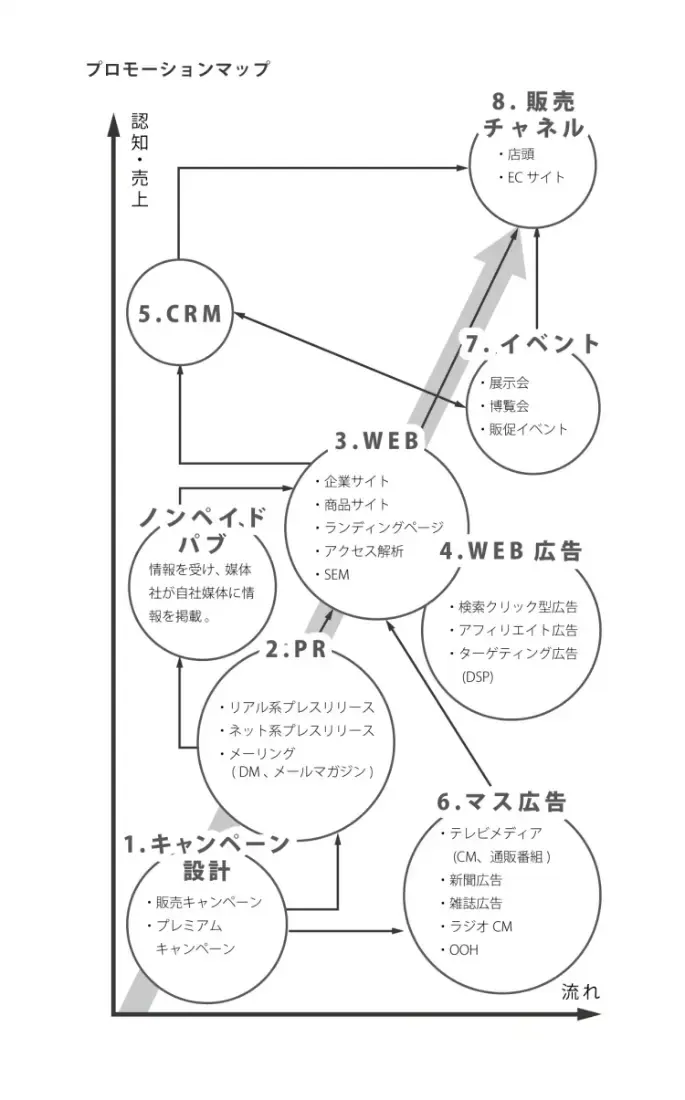
Now, let me explain the tips for designing this promotion.
Please look at the diagram. Put sales and awareness on the vertical axis and write out the promotion flow on the horizontal axis.
Next, place the campaign design at the lower left, and then plot all the elements needed for promotional activities (described later).
Purchasing products and services involves what is called consumer purchasing behavior.
For example, suppose you become aware of a product or service through advertising or the like.
Then, to decide whether to buy the product, you research it on websites and so on.
If you end up buying it, you then show it off to friends or post it on social media, further spreading awareness of the product or service to those around you. This is called consumer purchasing behavior. There are multiple purchasing patterns, and of course they differ from person to person. However, most patterns are common, and grasping them is necessary for promotion design.
Reading this consumer purchasing behavior, you first need to design the infrastructure for promotion.
First, if the product or service developed or procured as described above is good, it should make a social impact. It goes without saying that the quality of the product or service determines the success or failure of the promotion. It also keeps promotion costs down.
Now, the order of promotion starts with the campaign. A campaign is unnecessary if the product or service has considerable impact, but since it is an effective means of sales promotion, it should be considered once. For high-end brand products you need not do one, but please consider whether to implement one, taking into account what kind of product or service you have and the advantages and disadvantages of a campaign. If you do run a campaign, it may become the core of the promotion design, so it needs to be considered first.
After that, design the PR. PR here stands for press release, and is the activity of informing mainly the mass media about your products and services. The stronger the impact of the product or service, the more it generates, like the principle of leverage, coverage by many media outlets.
This is called “non-paid publicity.” It is a method of gaining publicity by having the media cover you through the company providing information and cooperation, without paying advertising fees. It is wasted if the media are not interested, but if it hits, you can get enormous publicity for free. Easy-to-understand examples include being featured on a TV variety/news show or being picked up by “YouTubers.” Such low-cost promotion design is also a feature of “Strategic Communication Design.”
Now, when many consumers learn about a product through this “non-paid publicity” and become interested, in most cases they will check it on websites and the like. Naturally, various measures are needed so that the website is easy to find in searches. After the website is found, consumers must then be led to purchase. Campaign design and introductions to stores and e-commerce sites need to be done accurately.
Also, if the product or service being launched is not expected to have impact, high-quality advertising placements are needed. These range from mass advertising such as TV commercials, magazine ads, newspaper ads and radio ads to the currently booming web advertising. For B2B (business-to-business), exhibiting at trade shows and the like is also part of promotional activities. In this way, by fully reading consumers' purchasing patterns and putting the infrastructure in place, dramatic sales promotion becomes possible.
Let me introduce an example of a unique promotion strategy.
It is the “miracle” brought about by “Shreddies,” a famous cereal brand in Canada. Ordinary Shreddies cereal is square, with a lattice-like pattern. The product was launched quite long ago; as its fans aged, consumption fell and an old-fashioned brand image had formed. As a result, sales slumped.
What was devised was a promotion carried out without changing the existing product. They simply placed the square Shreddies at a 45-degree angle, and since they looked like diamonds, launched them as a new product, “Diamond Shreddies.”
At that time, they ran a commercial claiming that “during the manufacturing process, diamond-shaped ‘Diamond Shreddies’ were born by chance.” It was just a joke, but this “punchline” became a talking point and spread online and by word of mouth. They also ran a popularity vote, “Are you a square fan or a diamond fan?”, which diamonds reportedly won 6 to 4, and there were even complaints like “I bought Diamond Shreddies but got squares.” This PR approach hit the mark, rejuvenating the brand image, and reportedly succeeded in raising sales 20% above normal. Even something this unremarkable can make a big difference just through how the PR is done. It is a true story that sounds like a lie.
Behind it was a victory achieved by organically linking mass advertising and the internet and skillfully spreading the buzz.
From the next section, I will introduce the components of this “promotion map.” It is only for reference, but please view it as a checklist of promotion elements.
The Components That Shape a Promotion Map
1. Campaign Design
A campaign generally refers to organized publicity activities. In particular, it refers to activities carried out over a set period for a specific purpose. In many cases, as part of a company's product launch plan or as gifts or prizes for purchasers, prize money, discount coupons, vouchers, home appliances, cars or other product-related novelty goods are given, and campaigns take many forms.
Advantages of Campaigns
By offering benefits or gifts to users for a limited period, for example to increase sales or acquire new members, you can expect increases in purchases and sales.
For example, with a special discount, more people will think “I want to buy it while I have the chance,” and making the “first purchase free” lowers the psychological hurdle for prospective customers and leads to new customer acquisition. By implementing various methods according to the product or service, there is the advantage of being able to aim for an increase in customers and purchases in a shorter period than usual.
Types of Campaigns
(1) Sales Campaigns
1. New product special price
This type includes “20% off new products from date X to date Y” or “20% off a limited quantity of X new products.” Simply being a “new product” boosts promotional effect. Adding a special discount leads even more people to purchase. It is a method for selling new products effectively.
2. First-purchase special price
A method that lowers the psychological hurdle for first-time buyers and leads them to purchase. Specific examples include “First-time customers can receive a 10,000-yen service for 5,000 yen” and “First time free.” It makes it easy to attract new customers and is a convenient method that can be used at any time.
3. Gifts
The common method of “Get △△ free when you purchase ○○.” It is even more attractive if the gift is related to the purchased product. It is a method long used to promote purchasing.
4. Trade-in sales
A method of taking back previously sold products and discounting by the trade-in value. It also ties in with the recent eco boom and helps improve image. For store-based businesses, customers visit the store for the trade-in, so “impulse add-on purchases” can also be expected.
5. Reservation discounts
Examples include “10% OFF for those who reserve” and “Those who reserve will receive X.” Taking reservations in advance lets you gauge sales volume to some extent and reduce inventory risk, so it benefits both users and sellers.
6. Money-back guarantee
A type of service such as “If you are not satisfied with the product, we promise a refund” or “Full refund if there is no effect within X days,” which leads to purchase by removing users' pre-purchase anxiety.
(2) Premium Campaigns
Premium campaigns are a standard sales promotion measure aimed at promoting product awareness and purchase. They can be broadly divided into the “open type,” which does not require a product purchase, and the “closed type,” which does.
1. Open type
By running simple quizzes that anyone can enter and offering luxurious premiums to generate buzz, this type has the effect of raising product awareness and encouraging sales.
2. Closed type
For example, a type that offers premiums only to those who have bought the product. There are gift-with-purchase premiums for all buyers, in-store lotteries, mail-in lottery premiums and so on, which can be expected to promote purchases and boost brand power.
Elements Important for Building Campaigns Going Forward
Until now, emphasis has been placed mostly on “mass promotion” as an adjunct to “advertising strategy,” but promotions aimed at “strengthening relationships with customers,” a communication function that “advertising” lacks, are increasing.
These are “focusing on existing and loyal customers,” “customer participation” and “communicating the company's stance and character to customers.”
The internet is being used in campaigns, and the trend toward engaging customers directly is expected to grow even stronger.
2. PR Measures
PR (Public Relations) refers to activities by companies and organizations aimed at having their opinions, ideas, positions and perspectives understood and spreading them.
For a company, the audience extends to every relevant stakeholder: the general public, consumers, employees and those connected with them, distributors, suppliers, shareholders and so on.
The most influential PR is exposure in media such as TV, magazines and newspapers. This is called “publicity”; unlike advertising, the highly public mass media cover and introduce a company's initiatives from a third-party perspective, making it possible to approach viewers and readers powerfully.
Advertising, in which you pay to “buy” space or time in the mass media, is business for the media too, so they will always run it. PR, however, is an activity in which the company's efforts lead the media to judge that “it is worth listening to,” and you need the media to come and cover you. In other words, if you pay, advertising will “certainly” gain media exposure, but PR is left to the media's judgment, so there is no guarantee of exposure.
PR can be said to be indispensable for building relationships of trust with all stakeholders and having them understand the company's value and merits over the long term.
Advantages of PR
The greatest advantage of PR is that it can be carried out at lower cost than advertising, but it also has the following effects.
(1) It increases the credibility of the company and its products
Like advertising, the purpose of PR is to increase sales of products and services, but that is not all. Having press releases and press conferences picked up as news by various media outlets raises credibility further. If you can highlight your ongoing R&D or your efforts on environmental issues, you can impress upon the public and stakeholders that you are an excellent company. You also gain credibility as a company that discloses information properly.
(2) It raises user awareness
By having a product or service featured as “information” in newspapers, magazines, TV, radio and so on, rather than one-way like advertising, awareness and trust among the public (public users) rise further.
Types of PR
With the development of media, means of spreading information more widely have increased, not only TV and newspapers but also blogs and social media on the internet. The main ways of releasing information at present include the following.
(1) Traditional press releases
Statements and materials issued by private companies and others for news organizations, with materials distributed to major mass media and industry newspapers and magazines.
If the content of the distributed materials is judged “interesting” or “newsworthy,” requests for coverage come in. By being interviewed and published, you gain media exposure, which leads to inquiries.
This is the conventional means, carried out by email, fax, mail, hand delivery and so on.
(1)-2 Online press releases
Press releases are issued to online media using online PR services. Online media here include websites, email and social media such as Facebook. Hybrid online press releases are also carried out, such as guiding people from email or print media to a website. Information is distributed simultaneously by fax and email to everything from major media to specialist publications, including magazines, newspapers, news sites, news agencies, TV, radio and free papers.
If the information attracts interest, as above, requests for coverage come in and you can gain media exposure.
Also, because it remains on the web as release information, there are cases where it is found in searches by users and companies and becomes a topic later.
(2) Mailings (DM, email newsletters)
If the company has a customer database, it can also do PR directly to customers. The main tool used here has been DM (direct mail), which mails information directly to customers. Also, if email addresses have been obtained, information is provided by sending emails directly to customers in bulk or regularly in the form of an email newsletter.
Since the audience is people already interested in the product or company, the advantage is that information can be delivered reliably.
3. Website Production
From the perspective of advertising media, web advertising overtook newspapers in Japan's advertising expenditures in fiscal 2012, and its importance has become irreplaceable. Today, it is no exaggeration to say that there is no company without a website.
There are various types of websites depending on purpose, such as corporate sites intended to provide a company's “corporate profile” and IR information, and online shops with functions to “attract” prospects on the web and even complete “sales”; producers also need to build them according to purpose. Since websites have the advantage of being quickly updatable, it is important to operate them with prompt responses that take advantage of this characteristic.
The story of the sports toy manufacturer explained in the earlier chapter on management philosophy has a sequel.
Yes, it concerns the subsequent effect of the website originally commissioned.
As I mentioned, when the website was commissioned we formulated the philosophy and corporate domain, but the president also had the request: “Not only users who actually buy through the website; I want to distribute our products to toy retailers with major stores. I also want to strongly convey that our company has a role as a trading company.” This made it clear that there were two targets. The direction was set to keep both in mind in producing the site, and to put particular effort into the distribution aspect that had been lacking until then.
And when it was completed, perhaps because the president's love for sports toys and the social contribution of the business came across, transactions with toy retailers expanded.
In fact, there are many cases where senior executives of companies engaged in business-to-business transactions such as B2B do not feel much need for a website. As evidence, many companies have not updated their websites in more than 10 years.
Generally, websites tend to be viewed more the higher the unit price of the products and services being traded. For example, for daily necessities such as beverages and snacks, people rarely compare products on websites first.
However, the more expensive the purchase, such as cars or houses, the more cautious consumers become, and they research in advance on websites.
The ultimate example is B2B transactions.
For example, suppose a manufacturer receives a presentation from a subcontractor that came to make a sales pitch.
The larger the transaction, the more the subcontractor's credibility and brand power are needed.
Sales activities usually use company brochures, but even if the person in charge at the manufacturer wants to accept the subcontractor's proposal, the approval of a superior is required.
Even with the brochure in hand, those superiors check up on the subcontractor and look at its website. In fact, when a certain company runs a sales campaign, access does tend to increase, and there are many cases where the information on the website was the deciding factor in landing a large deal.
Also, when manufacturers look for subcontractors, they quite often use websites as well.
Therefore, it is very important to properly reflect your company's characteristics and the content of your products and services on your website.
The same goes for recruiting employees. If you leave an unattractive website as it is, it is natural that new graduates and career changers will lose the desire to look your way.
(1) Sales promotion / sales support
By posting explanations, benefits, image, and the special qualities of your products, you can get web visitors to consider purchasing.
(2) Improving stakeholder trust
By posting corporate information, IR information, the special qualities of your products, awards and media coverage and so on, you can gain the trust of stakeholders such as purchasers, business partners and banks.
(3) Recruiting
The purpose is to use the site for recruitment. New graduates and mid-career candidates decide whether to apply after looking at the job requirements, business content, corporate philosophy and so on posted on the website, so if you neglect this, people will not come.
(4) Inquiries / orders
By introducing inquiry forms and cart functions on the website, you can connect to communication with visitors and to orders.
Types of Websites
Corporate site
A website that posts all of a company's information and is effectively the face of the company.
Purposes: sales support, improving stakeholder trust, recruiting, inquiries.
Campaign Website
A special site produced only when running a campaign for a product, company, service, etc. Purposes: sales promotion, inquiries, orders.
Product site (including service introduction sites)
A site that introduces information on products alone in detail. Often produced collectively by brand or series.
Purposes: sales support, sales promotion, inquiries, orders.
Landing page
A web page linked from internet ads or search engine results. A site that posts only information that matches the purpose of the search keyword and aims to convey products, services and information accurately. Usually produced with a simple single-page structure. It does not necessarily have to be the top page of your own site.
Purposes: sales promotion, orders.
Advantages of Using Web Advertising
Building sites and web promotions according to purpose makes it easier to achieve your goals. Compared with other media as a means of conveying information, a website has the advantage of being fully controllable by your own company.
There are various forms of selling over the internet, such as building your own e-commerce site or listing on major sales sites, and the distribution of sales and profit changes depending on the method. It is necessary to combine several methods to increase sales while raising product awareness through the internet.
How to Approach Web Advertising Operations
Web advertising is advertising that uses the web to draw people to a company's website, online shop and so on. All the advertising users encounter when using online services counts as web advertising.
There is something you must do before web advertising.
That is SEM (search engine marketing, sometimes also called SEO), which refers to techniques for getting your website displayed high in search results. As you know, when you enter search words into Yahoo! or Google, the target sites are displayed. For a company, whether or not it appears on the first page when this display occurs makes a world of difference in results such as sales.
Also, if you come to be displayed on the first page, you do not need to spend large sums on web advertising. Companies literally pour their heart and soul into SEM to get displayed on the first page.
Many related books have been published on this technique too, so please refer to them.
Unlike mass advertising aimed at a large audience whose viewers are unknown, web advertising can deliver different ads to individual users, for example by distributing according to viewer category or by analyzing interests and preferences from browsing and search behavior and changing the content delivered. Representative examples include “listing ads,” which grasp preferences from search keywords on search engines and display ads accordingly; “display ads,” which reflect preferences on the sites displayed; and “retargeting ads,” which are shown only to viewers who have visited even once.
Depending on how they are combined, web ads allow you to run the PDCA cycle effectively. Combine and operate them based on the characteristics of various ads. It is also important to use the analysis data from the ad delivery results obtained there in subsequent ad operations.
Types of Web Advertising
Web advertising has become increasingly diverse with advances in IT. In recent years, technologies for acquiring and analyzing vast amounts of anonymous data (big data) have advanced, and newer forms of web advertising can be expected to appear.
Against this background, the mainstream forms of web advertising at present include the following.
(1) Search click ads (listing ads)
Pay-per-click internet ads displayed on the search results screens of search engines such as Google and Yahoo! JAPAN, which make it easy to approach users with high interest.
Related ads can be displayed on the search results screen of people who search for specific keywords.
Currently, the two main search click ads available in Japan are Google's “AdWords,” which can place ads on Google, BIGLOBE, @nifty and others, and Overture's “Sponsored Search,” which can place ads on Yahoo! JAPAN, msn, FreshEYE and others.
Advantages of Search Click Ads
With search click ads, advertisers can freely choose the keywords for which ads are displayed when searched. There is also no limit on the number of keywords. Another attraction is the short time from placing an ad to its actual display (AdWords starts displaying immediately after placement except for some keywords; Overture starts within 5 business days).
If there are keywords closely related to your internet business for which it is difficult to rank high in search engines through SEO (search engine optimization, which makes it possible to appear high in search results), combining search click ads is effective. You can reliably display your site's URL on the search results screen for as many keywords of your choosing as you like.
Disadvantages of Search Click Ads
On the other hand, there are disadvantages. Because the fees for search click ads are linked to search volume, specifying “big words” such as “ramen” or “vegetables,” which apply to many fields and get many hits, can become expensive.
Also, even when specifying the same search words, prices may gradually rise for the ad company's own reasons, or the period of effectiveness for the same spending may become shorter.
(2) Affiliate ads
Performance-based internet advertising is “affiliate advertising.” Advertising fees are paid according to the number of final conversions, such as product purchases or requests for materials, or clicks, and there is basically no cost when ads are placed.
However, to use affiliate ads, you need to introduce an affiliate program into your website. Once you introduce an affiliate program, ads are placed on websites (= affiliate sites) and email newsletters participating in the program as publishers, and fees are determined by measuring only the final conversions generated via the ads.
Advantages of Affiliate Ads
With affiliate ads, advertising fees are charged according to the number of final conversions such as product purchases or requests for materials, not the cost of placing ads. The greatest advantage for advertisers, therefore, is eliminating wasted advertising costs and achieving results efficiently. When conversions occur, the advertiser pays the operators (= affiliates) of the websites and email newsletters where the affiliate ads are placed a preset reward according to the number of conversions. Those placing the ads also devise ad placement and ways of introducing products in order to obtain more conversions.
Disadvantages of Affiliate Ads
Because the ads placed are chosen by affiliate site operators, affiliate ads carry the following risks.
1. If not chosen by affiliates, the ads will not be placed at all.
2. Placement can be withdrawn at the affiliate's discretion, making it difficult to coordinate with campaigns and the like.
3. Ads may be placed on untrustworthy affiliate sites, so placement can actually damage credibility.
In other words, because affiliate ads are inexpensive, things may not go as the advertiser wishes.
(3) Targeting ads (DSP)
Targeted delivery ads (DSP) are a measure that delivers ads aimed at specific customers, further narrowing down user characteristics to draw users who are highly likely to convert to your site. Targeting ads can be classified mainly into four functions.
1. Retargeting
Ads can be shown to users who have visited your site at least once. Banner ads and text ads can be displayed when those users are viewing content on Yahoo!, Google or their affiliated partner sites.
2. Interest categories
For example, you select categories the target is likely to prefer, such as “organic & natural foods,” “gardening” and “farmers' markets,” and deliver ads to the matching targets.
3. Office targeting
Ads can be delivered to viewers in specified industries. This works well with B2B services and the like.
4. Others: area and weather-linked
You can deliver ads at registered locations, and also decide whether to deliver based on the weather at those registered locations.
Advantages of Targeting Ads
Ads can be delivered with pinpoint accuracy to a preset target segment. Not only does it enable precise targeted delivery by analyzing and narrowing down customers' search history data (data mining), but by adding a listing function it also eliminates investment risk for advertisers.
Disadvantages of Targeting Ads
Although DSP segments targets to some degree, those segments are only “estimates,” and at present it is not possible to deliver “precisely” and “exclusively” to ideal users.
(4) Other web ads
1. Social media ads
Ads displayed in the timelines of social media such as Twitter and Facebook. They can be expected to be shared and spread among users.
2. Advertorials (tie-up ads)
Ads produced not by the advertiser but by the publishing media (outlet) and published as part of its own content.
3. Blog ads
Ads in which celebrities or popular bloggers are asked to introduce a company's services or products on their blogs. Because articles are posted as first-hand experiences, they are highly credible and trustworthy, and because the articles remain permanently, long-term effects can be expected. However, overdoing it can cause a backlash as “stealth marketing,” so caution is needed.
4. Email ads
A general term for ads placed in electronic mail (email). They can be described as the email version of direct mail (DM). Among internet media, they are delivered by companies that hold member information.
4. Mass Media Advertising
Mass media generally refers to advertising in the four major media, namely newspapers, magazines, TV and radio, and it held an important position in traditional marketing activities.
However, internet advertising has risen beyond these four media and is accelerating its momentum as a medium more and more.
In particular, it is clear that users' main media touchpoints are shifting to mobile devices, and internet advertising, as a medium that connects directly with “specific individuals with high potential” rather than the “unspecified masses” of traditional mass advertising, is expected to expand its share of advertising further.
Currently, even TV, which has the largest share of advertising, has begun initiatives targeting mobile users, starting with the key stations.
For example, an environment in which people download apps such as “TVer,” a video streaming service for mobile by five Tokyo-based commercial broadcasters, and “AbemaTV,” formed by a TV station teaming up with an internet company, and enjoy missed programs and original content is rapidly spreading.
Appropriate use based on cross-media marketing between the traditional four mass media and the internet, especially mobile, is essential.
Deploying advertising through mass media, starting with commercials, is generally costly for spreading awareness, but it can be expected to make products and services widely known to an unspecified large audience in a relatively short period.
◯ TV Media
1.CM
Among Japan's commercial broadcasters, terrestrial stations, terrestrial-affiliated BS digital stations, radio stations and so on usually earn profit from advertising fees paid by advertisers (sponsors) by airing commercials; a single commercial on TV is typically 15 or 30 seconds, while on radio they range from 20 seconds to about 1 minute.
Its influence is said to have declined from its peak, but as long as you get the broadcast time and target right, it can be said to be strong.
2. Home-shopping programs (spot commercial format, infomercial format, caravan format)
A sales method that produces home-shopping programs and delivers directly to consumers. Costs vary among CS, BS and the commercial broadcasters, but by using the medium of TV, it is easy for consumers to understand and can appeal to them without a delay before purchase.
There are also various formats of home-shopping programs.
◯ Newspaper Advertising
Examples include publicity for various products and services and for the company itself. Many ads simply list the company or product name in a small space, but eye-catching full-page ads may themselves be picked up by other media, gaining further publicity.
Also, because newspaper ads are expensive to place and the pages are easy to keep, simply appearing in a newspaper ad can give consumers a sense of trust.
◯ Magazine Advertising
There are many kinds of magazines published, and a larger circulation does not necessarily make a more effective medium.
The choice of medium also changes depending on which audience you want to reach and your budget.
Some media have small circulations yet great influence in their industries; narrowing down the target is the key to keeping the aim of magazine advertising on track.
Whereas TV and newspaper ads are highly transient, magazines are passed around and kept, so their function differs from that of other mass media.
◯ Radio Commercials
A feature of radio commercials is that long-form (explanatory) commercials are possible, allowing them to be built not merely as announcements but around a story that holds listeners' interest.
As with TV commercials, they can be deployed as time (program sponsorship) or spot ads according to purpose. Compared with TV commercials, targeting segments can be said to be somewhat easier. There is little channel zapping, and since it is the only medium that does not use the eyes, people can listen while doing other things.
◯ OOH (Out of Home)
OOH (out of home) is a general term for advertising through media encountered outside the home, such as transit advertising and outdoor advertising. Typical examples are ads and signs inside trains and buses, on vehicle bodies, in stations, at airports, on building rooftops and walls, neon signs, and billboards along roads. It also includes ads at sports facilities such as baseball and soccer stadiums and ads on the temporary hoardings of buildings under construction. It is sometimes called “OOH media.” Recently, a marketing method that prints QR codes on flyers, posters, the edges of magazine ads and so on to guide people from OOH ads to mobile sites has become common.
Because almost anything outside the home can become an advertising medium, you can place ads optimally along users' daily routes. And since people see the ads directly, awareness of products and services builds quickly.
5.CRM
CRM stands for “Customer Relationship Management” and refers to a system for improving product sales and corporate profit margins by reviewing customer information, purchase information and customer relationships. When you handle low-priced products, products with thin margins, or products expected to be purchased repeatedly, building good, long-term relationships with customers is especially important.
Many books have been published on this topic as well, so please pick one up and look into it.
Incidentally, let me share a bad example I experienced myself.
Shortly after I got married, I visited an imported-car dealership in the two-seater convertible I had been driving since my single days. I was interested in a larger car in case we had children in the near future.
However, a couple in a two-seater gets no attention at a car dealership. And since we didn't have children yet, I didn't need a car right away either. Perhaps they sensed this: no one tried to sell to me, and I simply left my contact details so they could send me catalogs when new models came out. After that, the dealership sent me direct mail just once. Then, as expected, we had a child, and I bought an SUV at a different dealership. But that is not the end of the story. A few years later, I received a work request from the car manufacturer whose cars that dealership sold. Remarkably, it was about designing their CRM. What I learned was that, sure enough, neither the manufacturer nor the dealership had been running any CRM initiatives.
The essence of CRM is staying connected with customers over the long term by some means, monitoring how they change, and selling products and services at the right time. That dealership must have looked at our situation as a couple and decided we would not buy a car on the spot. But what really mattered was reading how that couple would change. In fact, companies that properly have this CRM mindset and capability are performing well.
6. Events
Events can be described as a product that enables real-world communication with actual users and with potential users interested in the target. In addition to events for general consumers, there are also formats such as trade shows, where you hold business meetings with buyers in a segmented venue, and announcements made to members of the press.
As promotional events, you can combine campaigns, sampling and touch & try experiences to raise awareness of services and products, and you can also expect feedback on user needs.
Benefits of events
By letting people directly experience a product or corporate brand, you can convey the intrinsic “goodness” of the thing itself, which is hard to communicate through one-way information delivery alone.
You can also spread information in a chain reaction, for example by inviting celebrities or media to the event or by launching a campaign page to coincide with a promotional event.
Events come in the following types.
(1) Trade shows
These are regular events planned so that companies can display their new products, goods and services in showcases or give demonstrations. Most are held in large venues such as convention centers, but the most suitable venue is generally chosen according to the theme and scale.
Typical examples include game shows and motor shows. By exhibiting at the trade show best suited to their company, product or service, exhibitors aim to build contacts with others in the industry, users and buyers, and to turn those contacts into business opportunities such as negotiations and sales.
Large trade shows are also covered by mass media such as TV stations, magazines and newspapers, so you can expect ripple effects afterward.
(2) Expositions
An exposition is an event that gathers goods, services, materials and the like from a wide range of fields and opens them to the public. The largest is the World Expo, and exhibits often take forward-looking themes.
For companies, exhibiting brings not only product sales but also benefits such as enhancing their corporate brand and corporate vision, making it an event that contributes greatly to branding.
(3) Promotional events
As part of sales promotion, these are events that drive product sales: sampling, in which touch & try experiences or promotional items are offered at commercial facilities such as stations and supermarkets; street promotions; and press conferences and new product launches. By letting users directly experience the merits of a product, you help them understand how good it is.
7. Purchase channels
What are store initiatives?
Retail storefronts are important for expanding a store's own sales, but the first step is to firmly establish the concept behind running the store. To do that, rather than leaving the store as merely a place to sell products, it is important to redefine it as a place to build relationships with customers, develop the brand and cultivate fans, and to make it a place that uncovers customers' issues and solves their problems.
I would like to introduce many store initiatives, such as the dominant strategy, but here too I will briefly cover only some of the key elements.
There are three points to consider in store strategy: the “upper-level concept,” the “middle-level concept” and the “lower-level concept.”
(1) Upper-level concept
The upper-level concept refers to store concepts and strategy: the thinking needed to re-examine and carry out what the store should communicate and do. Items to consider include the following.
- Conduct market research to select the best area and adjust the store space
- Re-examine the definition of the store
(2) Middle-level concept
The middle-level concept is the thinking required to actually operate the store. You need to consider the following.
- Make store operations variable and flexible
After calculating profit and loss, you need to hire an appropriate number of staff and make adjustments so the store turns a profit. For example, you might appoint a full-time employee as store manager and hire part-time workers as support staff. Few part-timers stay for long, and you can adjust staff numbers according to sales, which makes variable, flexible store management possible.
- Regular store checks
If you have multiple stores, you need to appoint and develop store supervisors who regularly check store management and maintain service quality.
- Establish a competency model
A “competency” refers to the behavior and thinking of a person or organization whose performance serves as a model. When running a store, you need a competency model that expresses “the kind of store we want to be.”
- Design campaigns
Another option is to design campaigns, such as introducing a points program or member discounts, centered on loyal customers, as a final push to encourage purchases at the closing stage.
(3) Lower-level concept
You need a standard way of thinking about internal system issues. The following are subject to consideration.
- Staff training
Train staff in customer service in order to “solve visitors' problems,” in other words, to raise customer satisfaction.
- Change the current POS system
For example, information managed stand-alone within individual departments cannot be used by other departments and becomes a black box. It is therefore necessary to make organizational or system changes to promote information sharing.
- Introduce an SV (supervisor) system
The larger an organization grows, the harder it becomes to share information and maintain employee quality. Surprisingly many companies face this problem.
In addition, as the number of stores grows and the number of part-time staff increases, turnover also rises, so you cannot provide training from scratch every time. This creates a need to solidify the training system.
So, to accurately communicate the intentions of senior management and keep the quality of the lower organization consistent, it becomes necessary to introduce an SV system with supervisors acting as coordinators.
- Award system
Everyone is happy to be praised. Once staff have raised their necessary skills to a certain level, you need a policy that motivates them to aim even higher. One relatively easy measure to introduce is increased bonuses or an award system. These have the effect of raising staff morale.
What is an e-commerce site?
EC stands for Electronic Commerce, and an EC site is a site that sells products and services online. There are two types of EC sites: the “own-site type” and the “mall type.”
The “own-site type” is a sales site built by the company itself, with shopping cart and payment functions customized for ease of use. Running an own-site EC business requires the same tasks as running a physical store, such as inventory management and order management, and those functions must also be built on the website. The “mall type” involves opening a store on an online mall such as Rakuten Ichiba or Amazon. Because you use the system built by the mall, you do not have to build inventory management, order management or payment systems yourself, which has the advantage of making it easy to get started.
Attribution analysis: something no one is actually doing
“Attribution” is a method of analyzing the “cost-effectiveness of advertising” for online ads displayed to people with certain specific tendencies.
In practice, attribution analysis focuses on calculating the cost-effectiveness of web advertising and understanding consumers' purchase paths and purchase intent, but in essence, you must calculate the cost-effectiveness not only of web ads but of all promotional spending.
As shown in the “promotion map,” promotion begins first of all with announcements. These include mass advertising and web advertising, as well as direct mail and mailings. Which means of announcement is appropriate differs by product or service, so you cannot know in advance which is optimal. Finding the right combination is the essence of attribution analysis, but in reality few companies seem to be performing this calculation.
There are several reasons for this, but I will omit them here.
What is the optimal distribution strategy?
When selling products, distribution strategy is important. Many experts have discussed how to define distribution strategy, but for you, the first thing is to think about how to build partnerships with companies, such as wholesalers and mass retailers, that will sell your products and services in bulk.
Once contracts with many distribution companies are in place, you can expect to sell large volumes of products and services, so the strategy for this part is also very important.
The most important point of distribution strategy is said to be developing distribution channels.
Trading companies, online retailers, agency networks and the like serve as these distribution channels.
To explain in more detail, distribution channels are divided into retailers, which deal directly with end users, the final purchasers of the product, and wholesalers, which do not.
Distribution channels also encompass commercial flow, physical flow and information flow. Breaking these down further, they can also be divided by sales process, for example customer development, order-taking sales, delivery and understanding needs. In distribution strategy, the basics are to divide each distribution channel by function and decide what to expect from each function and which channels to strengthen.
The significance of distribution strategy
Depending on the products handled, established business customs already exist. For certain products there may even be two tiers of wholesalers, and breaking that structure can be difficult.
If it can be broken, it becomes a “great distribution revolution” and a major business opportunity, but in most cases that will not happen.
Developing a distribution strategy requires considering many factors. It is no exaggeration to say that the key to business success lies in building a channel strategy that always looks ahead, taking into account market size, competitor trends, changes in the product life cycle and so on.
Below, I briefly introduce the basics of distribution strategy.
Basic policies of distribution strategy
(1) Open distribution policy
An open distribution policy distributes your products widely and openly, without limiting where they are sold.
While it has the advantage of rapidly expanding market share, it has disadvantages such as making channels difficult to control and sales management complicated.
It also has the disadvantage that distributors end up competing to sell the same product, which is likely to lead to falling prices, weaker brand power and a worse product image.
For this reason, this policy is better suited to high-volume, low-margin goods such as consumables than to luxury brand products.
(2) Selective distribution policy
A selective distribution policy selects distribution channels based on factors such as sales capability, financial strength, degree of cooperation and whether they handle competing products.
It has the advantage of allowing a moderate degree of control, but market share expands more slowly than with an open distribution policy.
(3) Exclusive distribution policy
An exclusive distribution policy grants exclusive sales rights to sellers for a specific region or product.
Such sellers are called agents or authorized dealers.
While it has the advantage of making channels easy to control and sales management simple, it has the disadvantage that, because there is no competition among the retailers serving as channels, they stop selling aggressively.