
Prologue
Using the web is now a must in corporate marketing activities
With the spread of smartphones, e-commerce and social media, it is no exaggeration to say that using the web in corporate marketing activities is now “a given.”
It is not unusual for advertisers to have a dedicated digital department, and many companies are devoting an ever-greater share of cost and effort to web promotion year after year—for example, spending as much on web advertising as on TV, which is considered expensive, or even more, or paying specialist firms several hundred thousand yen or more per month for website SEO and improvements.
The struggles promotion managers face in web promotion
Every client company has accumulated experience in web promotion, and although there are countless “web-specialist” partner companies for clients—advertising agencies that excel at web advertising, web companies specializing in SEO, companies specializing in content production for owned media and so on—promotion managers at client companies say things like:
“They say using the web in promotion is essential, but I don't know what the right thing to do is, or how to do it.”
“I'm just carrying out the web promotion our vendor proposed, exactly as they say, but there are no criteria for judging success, and I feel uneasy about whether this is OK...”
“We've asked an advertising agency to handle our web advertising, but they only report after the fact, and I'm dissatisfied with how they manage it. They don't propose anything about ad content, and I have doubts about whether they are properly handling day-to-day operations.”
“We signed a contract worth several hundred thousand yen a month just as the SEO company told us to, but they don't make the improvements we expect, and we can't feel any effect from their improvements.”
“We should have given them a proper orientation, but what our outsourcing partner proposes doesn't quite match what our company wants to do.”
We often hear such worries and complaints.
Pitfalls of web promotion and tips for avoiding trouble
“Just do web advertising and results will follow, right?” is wrong.
A common mistake client companies make is the misconception, “If we just do XX, sales will go up, right?”
If we build a website, more people will become interested and sales will go up; if we just run web ads, more people will learn about our products and sales will go up...
If it produces results, of course that is not wrong, but it is not necessarily true at all times and in all circumstances.
No matter how much traffic web advertising brings to your website, it will not lead to purchases if the website fails to convey the appeal of the product; and no matter how rich your website is, it is meaningless if the product's target audience does not view it.
Even if ads drive a lot of traffic to your website and you prepare rich web content, if the product itself is not appealing in the first place, consumers will see through it and pay no attention.
This applies to all management and marketing activities: promotion is the same as sports that require teamwork, such as soccer, basketball and rugby.
Each player (web ads, the website, etc.) sharpens their accuracy, makes precise passes and heads for the goal through connected passes. Loose balls are defended cooperatively, contributing to the team's victory.
Rather than thinking “if we just do this,” you must organically connect various measures in pursuit of “real results.”
To begin with, is that goal setting right?
A common pattern in web promotion is for the “company's person in charge of the web domain” and the “advertising agency for the web domain” to set goals from a limited perspective and proceed. These people often set the KGI (Key Goal Indicator) as e-commerce sales of XX yen or XX orders/inquiries, and KPIs (Key Performance Indicators) as a 20% increase in visitors or a 5% increase in CVR (conversion rate). That in itself is not wrong, but in many cases the “to begin with” perspective is missing.
The original perspectives—“What is this website being built for in the first place? Is the content currently posted right for that purpose?” and “What is this ad for?”—are lost. As a result, an owned media site meant to turn people into fans of Service A ends up bringing in articles that do not build fans of the service just to boost page views; or, for Product B, which has no name recognition, the budget is spent on improving the website, so there is neither sufficient ad exposure nor website traffic—or the web is not even suited to reaching the target in the first place...
You need to set KPIs for web promotion only after considering what challenges and goals exist across the entire marketing activity for the product or brand, and, on that basis, what you should expect from and what you need for web promotion as a whole, the website and web advertising. In some cases, this may mean not using the web at all, or rejecting the content of an existing website.
Be careful: especially when you consult a web-specialist partner company, the discussion often becomes “limited to the web domain.”
Conversely, a web-specialist partner company that asks questions about the product's or brand's marketing beyond the web domain, understands it, and designs accordingly will be a very powerful partner for the client company.
To achieve results: build an operational scheme for web promotion
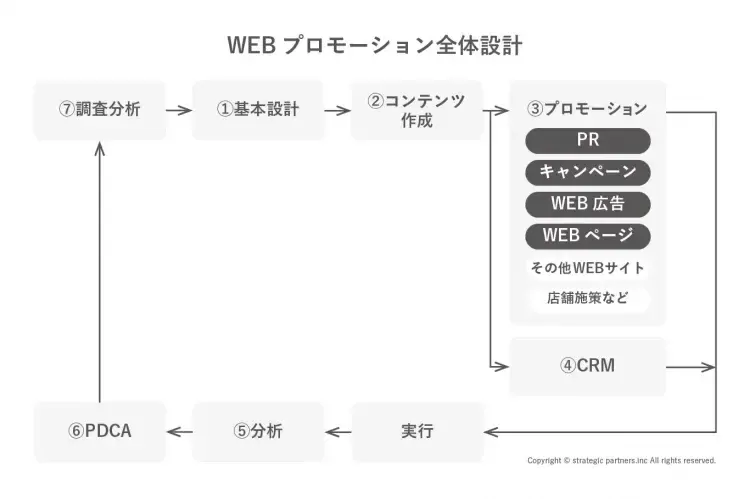
Web promotion involves everything from the basic design that defines the goal of the web promotion at that time and the path to reach it, such as objectives, targets and KPI settings; to content creation, deciding what to feature as the selling point of the product you want to sell (campaigns, new products, etc.); to designing the overall promotion and formulating individual measures such as web ads and the website; as well as PR, store measures if there are retail stores, and analysis after execution...
You must connect each measure as if flowing from upstream to downstream, and operate in a way that keeps the PDCA cycle turning to improve and maximize effectiveness.
The three key elements of web promotion
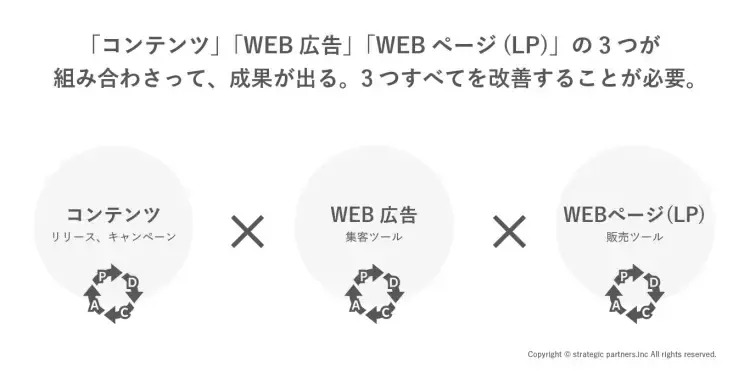
The three key elements of web promotion are “content,” “web advertising” and “web pages.”
No single element can produce results on its own; results are created by combining these three elements.
A) Content
Content such as “the product's appeal, brand and passion (that other companies don't have),” “new products” and “campaigns” that makes consumers think “this product interests me” or gives them the push to decide “I'll buy it!”
Just as a delicious ramen shop attracts customers without advertising, the content itself must be appealing in the first place.
B) Web advertising
(1) “Appeal techniques” that serve as hooks for consumers, such as fear appeals, influencer recommendations and diagnostic quizzes
(2) “Appeal channels”: choosing the right ads from listing ads, display ads, social media ads and so on, and optimizing budget allocation and ad exposure
(3) “Creative” such as text, visuals and video
C) Web pages
The web pages that receive traffic from web advertising.
It is common to produce LPs (landing pages) specialized for sales and tailored to the content of the ads. Since these are the pages viewed by users who clicked because they were attracted by what the web ad said, it is good to add more LPs to match the variations of your web ads.
In addition, since understanding of the product's strengths and value cannot be achieved through A) and B), they are an extremely important tool in pushing purchase decisions.
The biggest advantage of the web is that “you can measure the results numerically.”
Especially for B) web advertising and C) web pages,
(1) Don't treat them as finished once made; operate them while continuously improving based on interim results
(2) Create and deliver multiple patterns to find the most effective appeal techniques and creative (copy, graphics, video)
Let's do these things.
Is the client company providing enough information? Helping partner companies such as web advertising agencies and SEO firms deliver results
A common situation among client companies dissatisfied with web advertising agencies, SEO firms and the like is that they themselves are “not providing enough information.”
For example:
The strategy for the product is not made explicit (the goal of the measures has not been clarified)
Information that is easy to use for sales promotion, such as information on campaigns and new products, is not shared (within the client company, information is not passed from product managers to the in-house web advertising staff)
Where the challenges lie is not made explicit (it is unclear what is wanted)
In cases like these, the partner company lacks the underlying information it needs to develop proposals and measures, and even though it could make better proposals if this information were shared, the proposals and measures end up being shallow.
If your company recognizes itself in the above, simply improving how you provide information may increase the effectiveness of your web promotion.
Summary
The key points in web promotion are: don't think that just doing XX is enough; from a bird's-eye view of the business as a whole, consider what you want from the web domain, and then what the goal is for the web domain as a whole
Select a partner company that shares and empathizes with the above and can run alongside you
Design an operational scheme for web promotion as a whole that keeps the PDCA cycle turning
Combine the three key elements of web promotion—“content,” “web advertising” and “web pages”—in multiple variations and keep improving them
Share sufficient information with partner companies
These are the key points.
We hope this is helpful to those of you struggling with web promotion.