
Prologue
“Strategic planning” literally means “strategy formulation,” but in Japan the term is used incorrectly.
Why did it go in the wrong direction, and what is true “strategic planning”? In this column, we convey the correct interpretation of “strategic planning.”
How strategic planning has evolved in Japan
We will discuss the essence of “strategic planning” later; first, we explain how “strategic planning” is interpreted in Japan and why it came to be interpreted that way.
First, the interpretation in Japan.
Extracting the common text from the descriptions posted on various websites gives something like the following.
“Strategic planning is the most upstream marketing function within an advertising agency, developing clients' brand strategies, communication strategies and so on based on data. Before the job title of strategic planner was created, when mass advertising was mainstream, the role was called communication designer.”
The reason the interpretation has changed already appears here.
Until around 2005, advertising methods were simple. There was little research on consumer behavior, and AIDMA (*) was the mainstream model of behavior. For example, to advertise a product, companies with money used mass media advertising such as TV commercials (hereinafter, mass advertising), while companies without money used direct mail, flyers and the like; the means of advertising were used in a single, one-directional way.
*AIDMA (AIDMA) is one of the representative models explaining the consumer purchasing behavior process. AIDMA takes the initial letters of Attention → Interest → Desire → Memory → Action, and describes this as the standard purchasing process.
However, websites developed rapidly, and consumer behavior also changed—for example, consumers would visit a website after seeing a mass advertising announcement and then make a purchase from there.
It was also around 2005 that a method called “communication design” developed, organically linking various measures, such as driving traffic from mass advertising to websites or using the social media that had just started at the time. The title “communication designer” multiplied, mainly at advertising agencies, and it brought the benefit of comprehensively proposing and implementing campaigns for a single product or service requested by an advertiser.
This is where the advertising agencies' troubles began. Many advertisers shifted to web advertising, where the results of advertising effectiveness can be measured. At the same time, they began to doubt the effectiveness of mass advertising, which had tended to be vague until then.
Web advertising agencies that excelled at web advertising made great strides, while general advertising agencies that were not good at web advertising thought, “If we get to the core of management, customers (advertisers) won't leave us.” So they concluded that, beyond “communication design,” they needed to understand the advertiser's products and services themselves.
In this way, the title shifted from “communication designer” to “strategic planner.”
After all, advertising agencies are businesses too. At their core is selling advertising. “Strategic planning” tended to be used for the sake of those sales, and it has become “strategic planning in the narrow sense” rather than “strategic planning in the broad sense.”
Of course, “strategic planning in the narrow sense,” aimed at maximizing advertising effectiveness, is also valid.
However, once “strategic planning” becomes something formulated in order to sell advertising, it can fairly be called self-serving, and its effectiveness becomes questionable.
If true “strategic planning” is carried out, mass advertising may in some cases be unnecessary, and our company believes that “strategic planning” and advertising sales need to be considered separately.
The definition of strategic planning
The general interpretation of strategic planning is “corporate strategy formulation.”
Overseas, the following interpretation is mainstream.
“Strategic planning is the process of defining an organization's strategy or direction and deciding on allocating resources to pursue this strategy.”
“It may also extend to the process of guiding the implementation of the strategy. Strategic planning became prominent in corporations during the 1960s and remains an important aspect of strategic management. It is executed by strategic planners or strategists, who involve many parties and research sources in their analysis of the organization and its relationship to the environment in which it competes.”
「Strategic planning is an organization’s process of defining its strategy, or direction, and making decisions on allocating its resources to pursue this strategy.」
「It may also extend to control mechanisms for guiding the implementation of the strategy. Strategic planning became prominent in corporations during the 1960s and remains an important aspect of strategic management. It is executed by strategic planners or strategists, who involve many parties and research sources in their analysis of the organization and its relationship to the environment in which it competes.」
What do you think? Today, if someone calls themselves a “strategic planner,” from a global perspective, their planning must not be limited to advertising media and the like, as described above.
Rather, knowledge of corporate strategy as a whole is essential, and a “strategic planner” will be judged on that knowledge and experience.
In addition, (when a partner company of the client, such as an advertising agency, carries out strategic planning) it is actually a good thing to formulate marketing and promotion strategies based on an understanding of corporate strategy as a whole; but if it carries out “strategic planning” without knowledge of corporate strategy as a whole, it would be no exaggeration to suspect that it is intentionally steering the client toward the partner company's own business.
*Of course, we are not denying the partner company's business; the point is that you must determine whether that strategic planning is appropriate.
What True Strategic Planning Is
We would now like to explain what true “strategic planning” is, but before that, allow us to share something important.
*A detailed explanation is given in this column, [The World's Easiest Course in Formulating “Corporate Strategy”].
In fact, there is no single correct answer in “strategic planning.”
We realized this nine years ago, when our CEO was looking for a “strategic planning” manual for employee training. At first, he assumed that some publisher must have published an official manual. He searched high and low for such a manual, but never found an ideal one.
He looked worldwide, even searching through various academic papers, but found nothing useful.
In the end, deciding that if none existed we would make our own, we (truly) reluctantly began creating a “strategic planning” manual.
However, if we simply created it on our own, no one (neither clients nor employees) would trust the method.
We therefore decided to systematize “strategic planning” and conduct empirical research at an EU university with a proven track record in business education.
We discovered weaknesses in Philip Kotler's framework and created a standard corporate strategy framework, and at the same time (our CEO) earned a doctorate from that university.
That is our “6e.” It divides a company's activity elements into six perspectives, and our research showed that the strength of each element and the alignment among the six contribute to improving corporate performance.
Based on this “6e,” we broke everything down, from strategy to specific tactics, into a manual for employee training.
As a result, our employees can learn measures in both the broad and narrow sense, from formulating corporate philosophy and developing business models to branding and even SEO.
Even large consulting firms and advertising agencies probably do not undertake this kind of effort. We have built a (usable) “strategic planning” system as far as we, in our own way, could.
What is the “6e” strategic planning framework?
“6e” blends various corporate strategy tools on the basis of practical holistic marketing, classifies and arranges a company's activity elements into six categories—“1. Research & Analysis,” “2. Corporate Strategy,” “3. Business Strategy,” “4. Marketing,” “5. Management” and “6. Operations”—and, from these six perspectives, enables both overall and individual strategic approaches, including company analysis, corporate strategy, marketing strategy and management measures.
The greatest feature of “6e” is that, as an evolving framework, it incorporates know-how gained in actual projects as well as papers published in academic marketing and corporate strategy research, and through continued research is always kept up to date and continues to evolve.
“6e” has obtained both a patent and a trademark, and we aim for it to become a global standard framework in the future.
To date, our company boasts a track record of applying it to more than 1,000 companies, where it has been adopted as the strategy actually to be pursued. In other words, it has been verified in projects at more than 1,000 companies, and the know-how from implementing them has been fed back into and incorporated into “6e.” “6e” has no concept of strong or weak areas, because it is a “framework = way of thinking” specialized in solving problems.
“6e” makes it possible to derive answers from a “way of thinking” modeled as a framework, after conducting preliminary analysis that takes into account industry-specific issues, business practices and environmental factors.
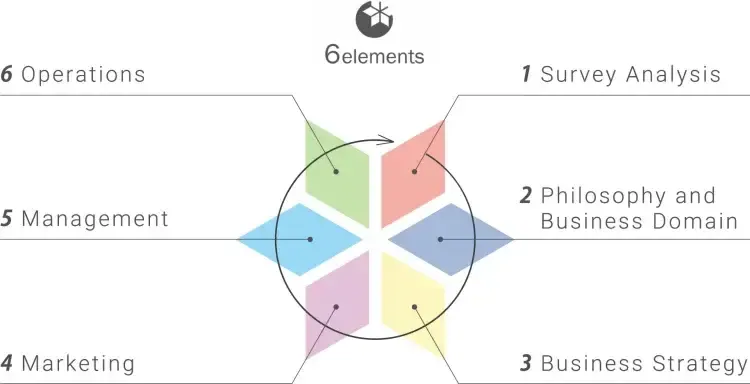
Companies with a high total score across the six components of a company also perform well. It is therefore known that measures to improve these six elements lead to improved corporate performance.
Epilogue
In this column, we have introduced “strategic planning.”
We hope it has been of some use to corporate executives who formulate corporate strategy and to corporate marketers in charge of marketing & promotion.
First, as the editorial policy of this column, we would like to write articles about the many misconceptions that have arisen in the industry.
After that, we would also like to introduce various strategy-related techniques and more.
Column articles are scheduled to be published on the 1st of every month.
Column scheduled for November
- The Dark Side of Japan's MBA Schools