
What does redefining a regional domain mean?
Today's episode is “Redefining a Regional Domain.”
In our work, we are often commissioned to formulate strategies such as “city promotion” and “city branding.”
With aims such as increasing the resident population and attracting tourists,
this work leverages the strengths of the city or town to find new value in the region, and not only strengthens residents' intention to stay but also promotes the region to prospective residents and tourists.
Attracting science-related companies to a town with a strong industrial image and redefining it as a cutting-edge science and technology city,
or adding renewable energy to a town with a nuclear power plant viewed as dangerous and branding it around building a sustainable society—
if there are ten cities or towns, each one requires a completely different redefinition.
The method of “redefining a regional domain” generally begins with rediscovering and unearthing the region's resources.
We pick one or more of these regional resources and create a new concept for the regional domain.
Once the concept is ready, we carry out PR and branding, and at the same time work to attract and activate related companies and organizations.
Therefore, going from “redefining a regional domain” to actually spreading awareness and seeing the effects of the measures is not something that can be achieved overnight.
Now, this time I will share a case of “redefining a regional domain” for a certain city.
As mentioned above, it is generally essential to start by looking for the region's strengths, but
in this region, things started from circumstances quite different from usual.
A region struck by tragedy
Eight years ago, I received a phone call from the head of one of our partner companies.
He wanted ideas for revitalizing a region struck by the Great East Japan Earthquake.
The region was M City.
It was a place hit by a compound disaster caused by the quake: the earthquake, the tsunami, and the Fukushima Daiichi Nuclear Power Plant accident.
We promptly went for an on-site inspection.
The city arranged the inspection schedule for us and even showed us around by car.
Even though six years had already passed since the disaster, its scars remained everywhere.
Houses deteriorating with no one left to live in them, and places where buildings had been demolished, leaving vacant lots.
There were also a few newly built houses here and there—perhaps a sign of people trying to rebuild their lives in this region.
It was a region where resignation and hope for the future were intermingled—
that is how I felt at the time.
What left a particularly strong impression on me
were the words of the city official who showed us around.
He said, “Due to radioactive contamination, it is difficult to reuse the land for agriculture, factories, or residential areas.”
Yes, naturally, the disaster had stripped the entire region of many of its strengths.
So, “how should we design the strategy?” It was a level of difficulty like never before.
Turning weaknesses into strengths
On the Shinkansen on the way back, I was mulling over how to design the strategy.
Then I suddenly recalled the words of the city official who had shown us around.
“Due to radioactive contamination, I think it is difficult to reuse the land for agriculture, factories, or residential areas.”
How could we use land that had become unusable?
That's when I came up with the idea of a runway.
With a runway, no crops would be grown and no one would live there, so radiation exposure would be kept to an absolute minimum.
“You can't just build an airfield that easily, and is there even demand for one in a rural area?”
You might have thought so.
However, although I had thought that land use was hopeless due to radioactive contamination,
it was the moment I realized the possibility that, by changing perspective, that weakness could be turned into a strength.
By the way, it's not an airfield.
To put it bluntly, it's a “space runway”!
A spaceport needs to be on the Pacific side,
and it requires a vast site.
Of course, a spaceport is not something that can be built easily either.
But this idea proved useful in the actual strategy formulation.
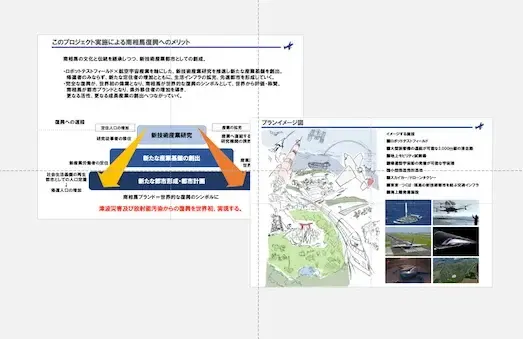
And then, the proposal to the city
From there, we formulated the strategy jointly with the partner company mentioned above.
Because the city had already been allocated a disaster reconstruction budget,
research institutes for robot development and drone development were already in place.
By adding the “aerospace industry” to that, we redefined it as a region with new technology industries.
We divided the plan into Phases 1 through 3,
starting with developing small aircraft and creating a new “aerospace industry” department at a vocational school—building a system in which industry and human resources grow together—and ending with the entry of space-related industries.
We then compiled it into a proposal for the city.
And then came the day of the proposal.
Under a thinly overcast sky, we entered a conference room at city hall.
From the city, the deputy mayor and several officials attended,
and on our side there were four of us, including staff from the partner company mentioned above.
We began the proposal right away, and about ten minutes in, as I was explaining the core of the proposal,
something strange happened.
I said, “By bringing in the aerospace industry (omitted)... in this way, we will ‘turn a town of tragedy into a town of hope’!”
At that very moment, there was a huge clap of thunder!?
There was a window behind where I was sitting, and the officials were seated facing it, so everyone seemed quite startled (laughs).
“What an impressive bit of staging...”
I still remember being told that.
That was the one and only thunderclap, before or after.
It wasn't even the kind of weather for thunder under a thinly overcast sky...
Oops, I've digressed.
Back to the main topic.
And now, eight years later
Let me tell you what happened to that proposal afterward.
The city began considering the introduction of the “aerospace industry” and set up a preparatory office.
Execution was entrusted to the partner company, and in the form of a secondment from our company,
we decided to support that work.
First, building a runway for test aircraft, providing technical advice to the vocational school,
and developing new aircraft (details to be shared later), among other things—gradually, but
we are steadily moving the project forward.
Now, as for how the Phase 3 spaceport will be achieved,
please allow me to keep that a trade secret.
This summer, I will also visit space-related companies in the United States.
We have no intention of giving up on our goal of building a spaceport in Japan, no matter what.
If there is anything I can disclose, I will report it in this column, so stay tuned.
Since we've had a run of rather large-scale strategy cases,
next time I will introduce a very small—and tear-jerking—strategy case.
Written by: Hiroshi Ashida