
Introduction
We are starting a new series in our Column: the “Episode Series.”
Companies similar to ours often present their “track records” on the web or on TV, and this sometimes gives me pause.
First: “Your achievements are never something you accomplished alone...”
After all, there are almost no projects that one person can complete alone. So I believe it is ethically questionable to present work as if “I accomplished this.” Projects are achieved through the cooperation of many people, and out of consideration for the feelings of those collaborators, one must be quite careful when “presenting achievements” as self-promotion.
Second, besides presenting “track records” without the client’s permission, we also often see companies that handled only a tiny part of a project claiming that “our company made this project a success.”
In any case, our company is quite reluctant to present “track records” in this way. For that reason, we do not do much “track record presentation” on our website.
That said, we do have some “track records” that are a little interesting and that may be useful to you.
We will present these various strategy cases as fiction based on true stories (in episode form).
We hope reading them will give you an opportunity to discover “the appeal and effectiveness of strategy.”
A Major Automaker Launches Innovation Branding
About ten years ago, through “a certain connection,” we came to work with Mr. S, an engineer at a major automaker (category brand).
At the time, our company was continuing to produce the operation of the domestic races of an “international air race,” and we also managed one of its pilots.
The “certain connection” mentioned above was that Mr. S had an opportunity to meet the pilot. On that occasion, they found that the sports car Mr. S was developing had many things in common with airplanes, and he consulted our company about whether these commonalities could be given some kind of form.
According to Mr. S, although his company’s car brand aimed to be a luxury brand, it had ended up as the epitome of “a car driven by middle-aged men,” and its ranking among domestic brands was also sluggish.
Mr. S said he wanted to position his company’s car brand alongside Mercedes-Benz and BMW.
As one way to break through, since the brand had until then released only sedan-type cars, he believed that developing a sports car would allow it to express “dynamism” and “excitement,” even as a luxury car.
And so we began designing the strategy.
During our research, we discovered that the sports car had been developed with “a relentless pursuit of aerodynamics” (perhaps a matter of course).
This was the biggest thing it had in common with airplanes.
As a rule, airplanes undergo exhaustive wind tunnel testing and aerodynamic calculations, which produce those beautiful, streamlined airframes.
The sports car under development was based on the same thinking.
We therefore decided to build a strategy starting from this “common ground.”
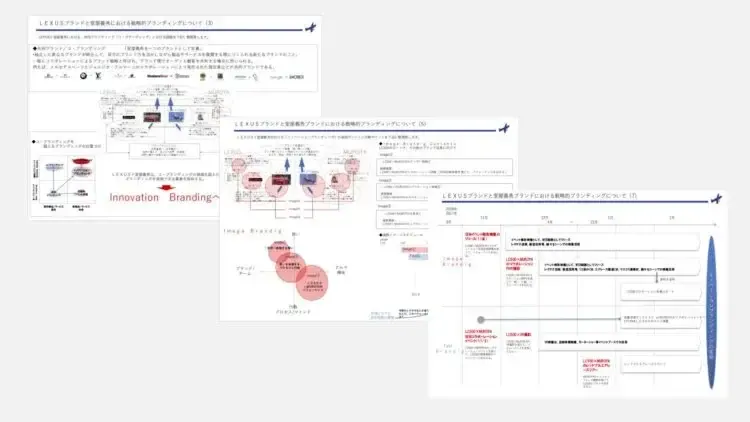
That was “Innovation Branding.”
It is widely common for companies to engage actors, celebrities, athletes and the like and incorporate them into their branding strategies.
However, this is a passive approach that uses the brand image of celebrities or athletes to raise the company’s own brand.
One step further is “co-branding,” a marketing method in which multiple companies or brands collaborate on branding. Also called co-creation branding, it is especially common in Europe and the United States. Its advantage is that companies can jointly achieve goals that are difficult with single-brand branding, such as raising awareness and strengthening brand value.
Going even beyond that is “Innovation Branding.”
Its aim extends to partnering with companies, IP holders, actors and others to create “something innovative.”
So in this case, rather than using the pilot as an image character, we designed a strategy in which both parties would resonate with and co-create with each other, raising each other up.
Specifically, it was:
- Communicating each other’s activities through events, social media, etc.
- Supporting each other’s goals through technical exchange
That was the plan.
And so the project started that same year.
The Activities Begin
In 2016, the pilot managed by our company also continued to struggle in the “air race” standings.
The automaker likewise gained no brand-boosting effect from the struggling pilot, and its brand remained low for some time.
But neither Mr. S nor the pilot cared about that.
They were aiming for a comeback through “Innovation Branding.”
As part of these activities, the automaker supported the development of the race plane,
and the pilot supported the development of the car.
Their efforts paid off, and in 2017 the pilot won the overall championship in the “air race.”
For the automaker, too, in 2020 a sports car utilizing aviation technology sold out its pre-orders within a week,
and thus the signal fire for the comeback was lit!
An Unexpected Turn
And so the automaker, which had been struggling with a sluggish brand, gradually climbed the brand rankings, and in 2020 Mr. S became president of that brand. This was surely not solely the result of “Innovation Branding,” but it is probably fair to say it was one of the factors that influenced his appointment.
Then, in 2023, Mr. S went from president of the automaker’s category brand to president of the automaker itself.
He was now entrusted with steering the world’s largest automaker.
* Incidentally, this year the category brand has finally taken first place in every brand ranking.
If I may boast a little, I had actually predicted that Mr. S would become president.
Many people around me said, “Surely that’s impossible? It’s such a huge company, with so many executives between the then-president and Mr. S. Wouldn’t it be difficult to be promoted over several levels at once?”
There were many voices like that.
However, there was Mr. S’s foresight, his cleverness, his ability to execute, his openness to accepting our proposals, and above all, the fact that he “loves cars.”
That is why I believed Mr. S was suited to lead the fast-changing automotive industry.
Incidentally, Mr. S and the pilot still maintain a good relationship today.
Reflecting on this episode, I still shudder to think that “strategy” influences not only “people” but also, to no small degree, “companies” and even “industries.”
We will continue to keep ourselves sharp and strive to improve our strategic capabilities.
Written by: Hiroshi Ashida