From “building fast” to “building securely and operating with peace of mind."
A web production service that redesigns website production, quality control, publishing and operation around “AI generation × Git management × automated verification × human approval.” In addition to making production more efficient with AI, we reduce the components running in the public environment to shrink the attack surface for cyberattacks, and make mechanisms for rolling back instantly in the event of failure standard. For CMSs (WordPress, etc.), we choose to “remove, keep, or combine” depending on the characteristics of the site.
BackgroundWhy change how websites are built now?
01An era in which AI can “build, fix and propose"
AI development tools can now read code, and even edit, test and create change requests.
02The risk of cyberattacks targeting websites
In October 2026, a critical vulnerability in PHP enabling arbitrary code execution without authentication was disclosed, leading even government ministries to temporarily suspend web content.
03Git-integrated static hosting has become mainstream
Simply pushing changes triggers automatic builds and CDN delivery. Both publishing and rolling back to the previous version can be done instantly.
Conventional CMSs can also be operated securely if updates, configuration and monitoring are handled properly. The difference lies in “the number of things that must be continuously protected” and “the work required in an emergency."
WorkflowWeb production flow for the AI era
We proceed through 7 steps and 5 approval gates (G1–G5). AI handles the labor-intensive parts, while people judge requirements, quality and whether to publish.
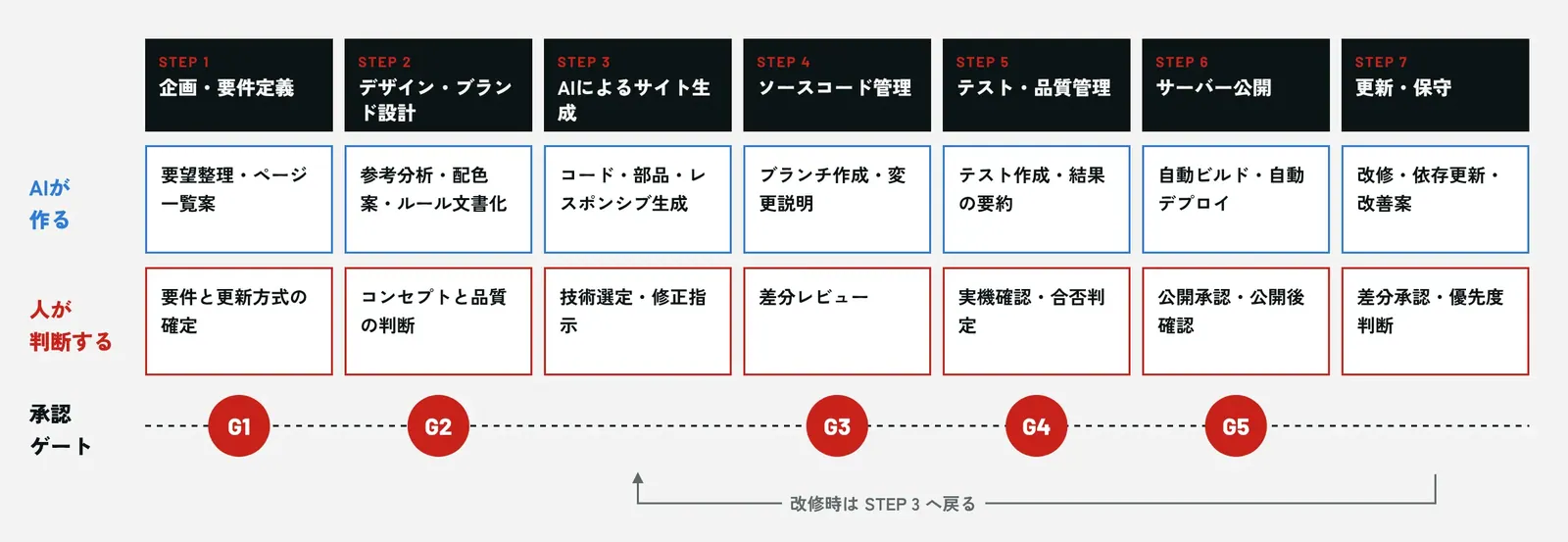
AIAI builds
The labor-intensive parts, such as generation, fixes, test creation and change descriptions
HumanPeople decide
Decide requirements, quality and whether to publish at 5 approval gates
SystemProtected by systems
With Git, automated tests and automated deployment, the same procedure is followed no matter who does the work
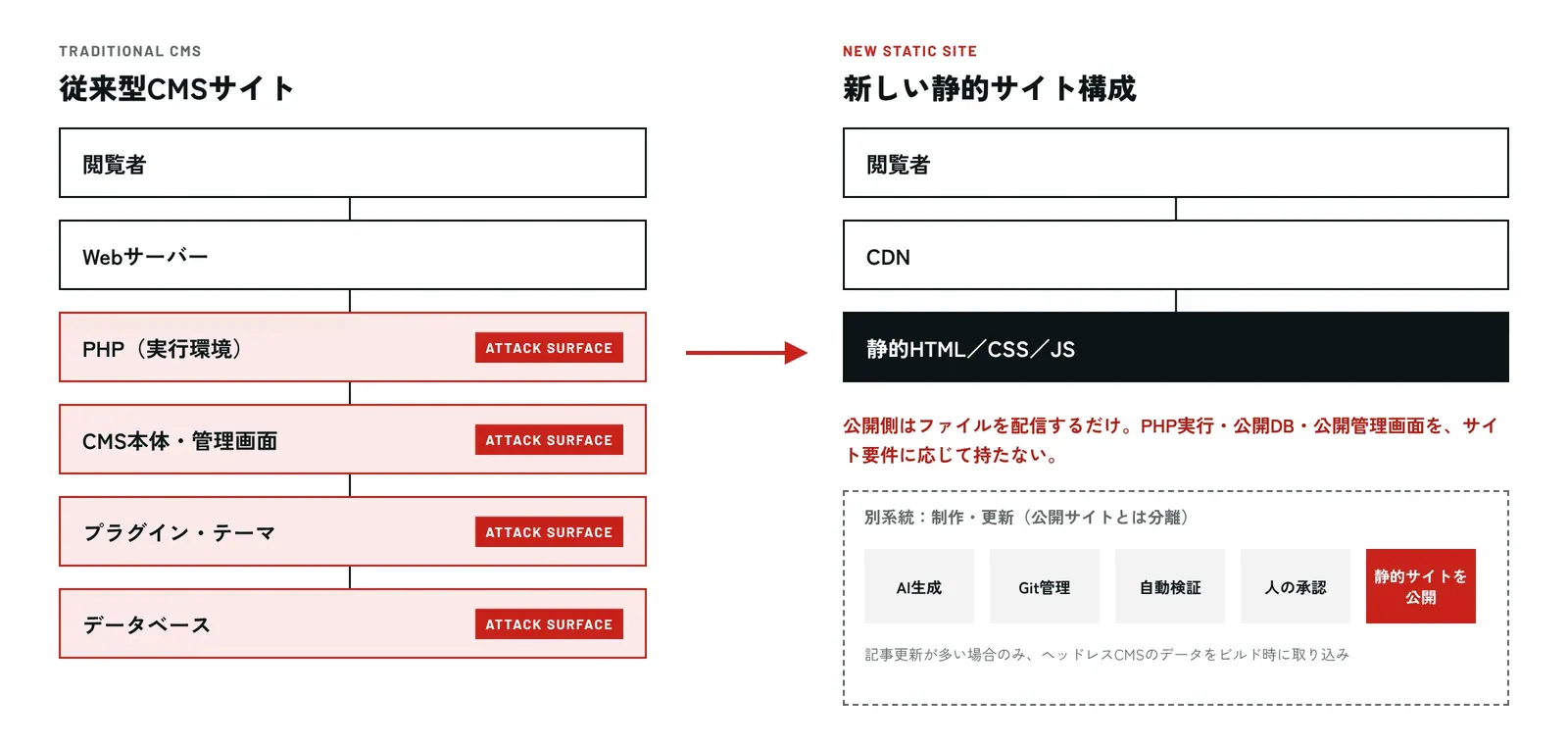
SecurityA new website architecture that reduces the attack surface
We reduce the components running in the public environment, cutting down the very parts that can be attacked. The public side only serves files, while production and updates take place in a system separate from the public site and are reflected only after the differences have been reviewed and approved.
| Aspect | A Conventional CMS | B Direct operation of AI-generated code | C AI-generated + headless CMS |
|---|---|---|---|
| Emergency vulnerability response | Emergency updates to PHP, CMS and plugins on the public server. If difficult, decide whether to take the site down | Since PHP does not run in the public environment, direct responses stemming from PHP are easier to avoid | Public pages are the same as B. CMS core updates are handled by the CMS provider (for SaaS types) |
| Attack surface | PHP execution, database and admin panel are on the public server | Mainly static file delivery. Forms, etc. use external services | Public side is static delivery. Admin panel is separated from the public site |
| Recovery from failures | Restore by aligning the state of the server, database and plugins | Redeploy a known-good version from Git | Code is redeployed; content restored from CMS backups |
Even with a static site, management of GitHub, CMS and hosting accounts, dependency packages, external forms and the like is still required. It does not prevent every threat.
CMSCMS: not “remove” but “choose"
There is no one-size-fits-all approach. We choose the optimal approach based on the volume of updates and who will handle them.
| Site type | Recommended approach | Who updates |
|---|---|---|
| Small corporate site (up to 20 pages, updated a few times a year) | B Direct operation | Production company (on request) |
| Mid-sized corporate site | C Combined (CMS for news and works only) | Client (articles) + production company (static pages) |
| Recruitment site | B or C | HR (job postings) + production company |
| LP / campaign | B Direct operation | Production company / marketing staff |
| News / blog | C or A | Client's editors |
| Sites with many products and services / multilingual sites | C Combined | Client's respective staff |
| Membership sites / web apps | Custom design | Development team |
Since there is no CMS build process, initial work hours are easier to keep down for sites with few updates. For sites with frequent article updates, keeping a CMS keeps operating costs lower, so we agree on the update approach at the proposal stage before proceeding.
QualityQuality in two layers: “automated checks” and “human judgment"
| Area checked | Automated checks (every time a change is made) | Human review (before approval) |
|---|---|---|
| Display / browser compatibility | Display tests and screen comparisons for key pages, automated tests on major browsers | Appearance on actual PCs and smartphones, consistency with design intent |
| Links / forms | Broken-link detection, form submission tests | Checking auto-reply emails, notification recipients and wording |
| SEO / page speed | Presence of titles, descriptions, OGP, etc.; page speed measurement | Appropriateness of content; balance between image/video quality and file size |
| Accessibility | Automated checks for contrast, alt text, etc. | Checks with keyboard navigation and screen readers |
| Security | Scanning for leaked secrets, vulnerability alerts for dependency packages | Checking external scripts, form destinations and permission settings |
The author and the approver are different people. Changes made by AI are always published only after going through “change request → automated verification → approval."
RecoveryOperations that make recovery easy, even after attacks or failures
| Recovery flow | |
|---|---|
| Conventional approach (example) | Problem discovered → impact investigation → check CMS, PHP, plugins and database → fix → functional verification → resume publishing |
| New approach (example) | Problem discovered → confirm scope of impact → select a known-good version from history → redeploy → verify |
Because known-good code and the publishing history remain in Git and the hosting service, it is clear what to roll back to. We routinely retain deployment history, regularly rehearse rollback procedures, and back up CMS data and form data.
* Even with the new approach, root-cause investigation, revoking and reissuing passwords and tokens, and checking external services are still necessary. Account compromise and data loss cannot be resolved by redeployment alone.
Growth CycleKeep updating and improving after launch
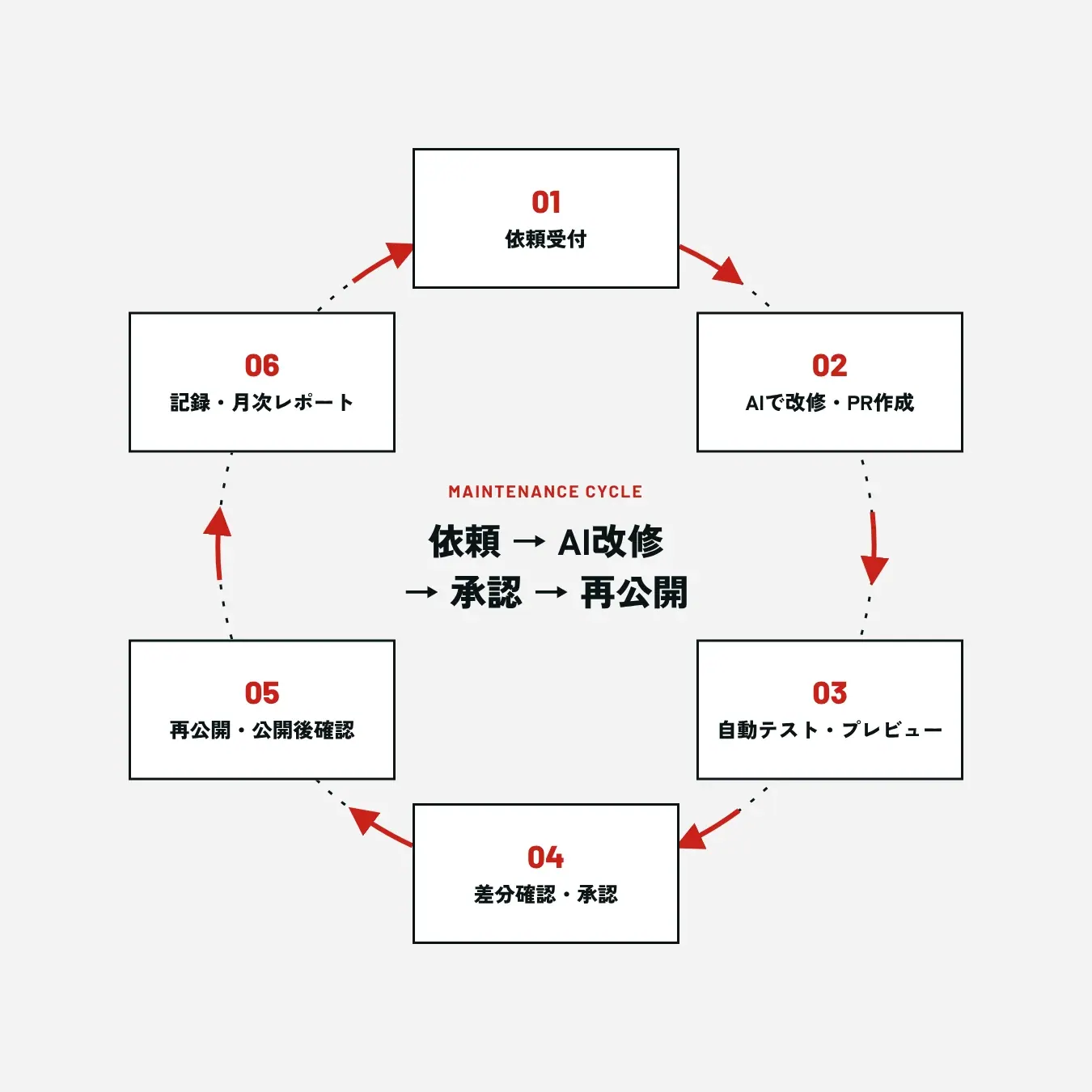
01Update | Just give instructions
Give instructions for updates in natural language, and AI creates a draft.
02Publish | Automatic after approval
After preview review and approval, static pages are generated and published automatically.
03Measure | LLMO / CRO
We visualize how you are mentioned in generative AI (LLMO) and the improvement points revealed by visitor behavior (CRO).
04Insight | People decide
Based on “what should be fixed next,” we prioritize modifications and feed them into the next update.
Routine tasks: checking dependency package updates (weekly); improvement proposals based on access analytics, LLMO and CRO, and backup restore tests (monthly); uptime monitoring, SSL expiry and form delivery monitoring (continuous).
ValueTurning your website into a corporate asset you can operate with confidence
01SECURITY | Reduced attack surface
Fewer components running in the public environment, reducing attack targets.
02COST | Optimized long-term maintenance burden
Fewer items requiring ongoing maintenance, with operating costs optimized to the site's characteristics.
03SPEED | Rapid production and modification
AI shortens the time from kickoff to launch.
04QUALITY | Standardized testing and approval
Change diffs, verification results, approvers and publishing history can all be reviewed.
05CONTINUITY | Established history and recovery procedures
Recovery procedures for failures can be standardized.